• The Risks of Faith: Exploring Abraham’s Journey as a Biblical Patriarch

    One of the major characters in the Bible that many would call a patriarch is Abram, better known as Abraham. Like many Bible characters who lived before the time of King David (before 1040 BC), it is hard to know much about these patriarchs. We not only lack what is referred to as reliable historical information but there also isn’t any archaeological evidence that proves the existence of Abraham. Along with Moses, we believe that Abraham lived because the Bible tells us so, in Genesis 12 (NKJV): 

    1 Now the LORD had said unto Abram, Get thee out of thy country, and from thy kindred, and from thy father’s house, unto a land that I will shew thee: 2 And I will make of thee a great nation, and I will bless thee, and make thy name great; and though shalt be a blessing: 3 And I will bless them that bless thee, and curse him that curseth thee: and in thee shall all families of the earth be blessed. 

    Genesis 12 begins a new division in the book of Genesis. The first eleven chapters are called “primeval history.” These chapters convey the story of the first years of the world’s existence and are usually divided into three main parts: the creation and fall of humankind (chapters 1-6); the Flood (chapters 6-9); and the Flood to Abraham (chapters 9-11). The last chapters of Genesis are known as “patriarchal history.” Pastor Bob Deffinbaugh writes:

    While the effect of man’s sin has become increasingly widespread, the fulfillment of the promise of God in Genesis 3:15 has become more selective. The Redeemer was to come from the seed of the woman (Genesis 3:15), the from the descendants of Seth, then Noah, and now Abraham (Genesis 12:2-3). 

    Theologically, Genesis chapter 12 is one of the key Old Testament passages, for it contains what has been called the Abrahamic Covenant. This covenant is the thread which ties the rest of the Old Testament together. It is critical to a correct understanding of Bible prophecy.

    Rabbi Joseph Telushkin also has an interesting observation about Abraham and writes: 

    The Torah nowhere explains why God chooses Abraham for this mission, though Jewish tradition claims it is because he is the first monotheist since the time of Noah. A Jewish legend teaches that Abraham’s father, Terakh, owned an idol shop. One day, while his father was away and Abraham was in charge of the store, he smashed all the idols but the biggest with an ax, and then put the ax in the remaining idol’s hand. To his outraged father’s question as to what had happened, Abraham explained that the large idol became upset at the other idols and destroyed them. 

    “You know these idols can’t move,” Terakh shouted.

    “If they can’t save themselves,” Abraham answered, “then we are superior to them. So why should we worship them?” 

    Because this rabbinic tale is taught to almost all children in Jewish schools, many Jews mistakenly believe that it is in the Torah itself.

    As we continue reviewing the text, Yahweh speaks to Abram, and his words are: 

    1 The LORD had said to Abram, “Go from your country, your people and your father’s household to the land I will show you. (NIV)

    What does it mean for Abram to leave his country? In some ways, we can imagine what it would be like telling a young man or woman, “Now is the time for you to go and pursue a college education.” Depending on what field of study one chooses, and how badly one wants to leave their parents, some students might pick a college several states away. 

    But Abram is not a young man going off to college. He is 75 years old. This is a different culture compared to what we know. 75-year-old people are usually not thinking about leaving home, unless, of course, it is a nursing home. Many 75-year-olds we know are enjoying a peaceful lifestyle living in their retirement communities, not thinking of taking off and leaving their family behind. Yet, here we have Abram faced with this task, as Yahweh continues:

    2 I shall make a great nation, I shall bless you and make your name famous; you are to be a blessing! 3 I shall bless those who bless you, and shall curse those who curse you, and all clans on earth will bless themselves by you. (NIV)
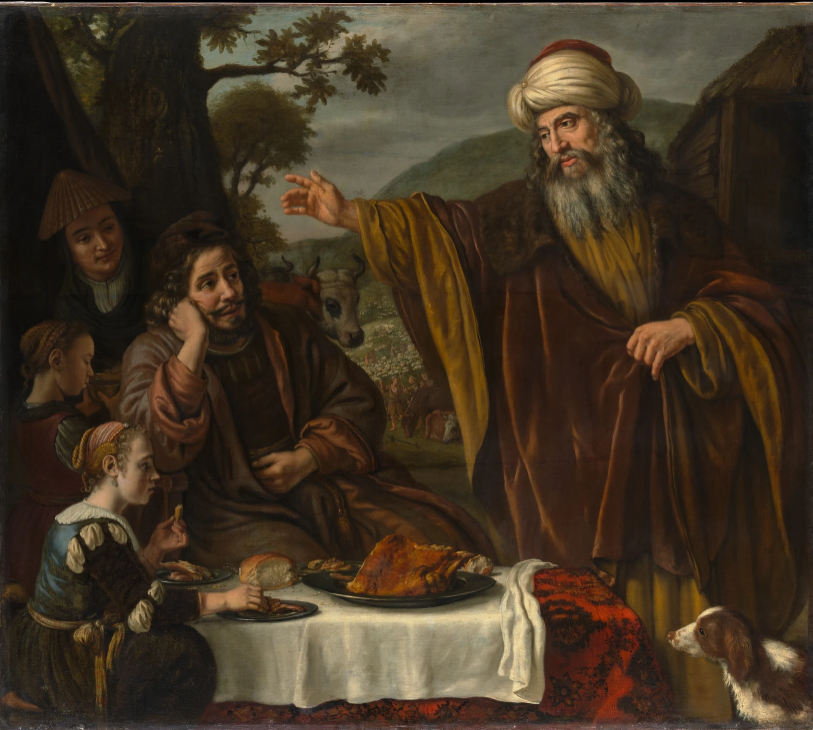
    Abraham's Parting from the Family of Lot Jan Victors 1655
    Abraham’s Parting from the Family of Lot Jan Victors 1655

    Abram surely knew that what was promised to him was not going to be something that he would live to see in its entirety or even his lifetime. But it did not matter because the promise was enough for Abram to step out and obey. Abram was willing to take that risk. 

    How are we doing when it comes to taking risks? Our culture teaches us that once we’ve reached 75 it’s time to settle down, not get up and start out on a whole new journey. But the Christian faith is a new journey. Nowhere in the Bible does it mention “retired Christians.” Yet some have that attitude. 

    Some may try to justify being a retired Christian. They might stop being involved in church activities or not participate in the gospel message. But the Bible doesn’t give a pass. Christians continue to live by faith and take risks as they are led by God. 

    Abram took a risk by leaving his homeland to journey off into unfamiliar territory. Jesus Christ also took many risks, as he continued to preach the message and help the sick while going to Jerusalem where he’d be crucified. Let’s consider modeling our lives after Abram (and Jesus) who are risk takers. Let each of us ask ourselves; what risks does God have for me to take today? 

    Title: Taking a Risk | Sermon: February 28, 1999 First Christian Church, LaJunta, Colorado

    Sources:

    • Bob Deffinbaugh. May 12, 2004. “12. The Call of Abram (Genesis 11:31-12:9).” Bible.org.
    • Rabbi Joseph Telushkin, Jewish Literacy (New York:  William Morrow and Company, Inc., 1991, 30.

  • “He is Greatly Exalted:” Celebrating Christ’s Resurrection this Easter in Psalm 47

    Before we jump into the celebration this Easter Sunday, I want to rewind a moment back to when Jesus was on the cross, Luke 23:39-43 (NCV): 

    39 One of the criminals on a cross began to shout insults at Jesus: “Aren’t you the Christ? Then save yourself and us.”
    40 But the other criminal stopped him and said, “You should fear God! You are getting the same punishment he is. 41 We are punished justly, getting what we deserve for what we did. But this man has done nothing wrong.” 42 Then he said, “Jesus, remember me when you come into your kingdom.”
    43 Jesus said to him, “I tell you the truth, today you will be with me in paradise.” 

    Luke tells us that “the other criminal” on the cross… 

    • Acknowledged his wrongdoings. 
    • He accepted his justified punishment.
    • He believed in Jesus and asked Jesus to remember him.
    • He had faith that Jesus was the Messiah of God.
    • He believed there was a “kingdom” of God.
    • He believed there was a life after death!  

    Those who stood under the cross and witnessed the thief’s ramblings must have thought these men were out of their minds. But this sinner had faith. He called upon the name of the Lord and was saved.

    With this in mind, let us look at Psalm 47.1-2: 

    1 Oh, clap your hands, all you peoples!
    Shout to God with the voice of triumph!
    2 For the Lord Most High is awesome; 
    He is great a King over all the earth

    On Resurrection Sunday, which we also refer to as Easter, we gather to celebrate the resurrection power of our risen Lord. Christ is risen! Christ is risen indeed!  Isn’t that what it is all about?

    This is often a day we welcome the CEO Christians (Christian-Easter-Only Christians) into our church. Which leaves us asking, why this Sunday? Why today? Why did you come to church this morning?  For some people:

    • I wanted to see the pretty flowers.
    • I wanted to show off my new clothes.
    • I am here because that is what my family wanted to do today.
    • I am here because I always attend church on Christmas and Easter.
    • I am here because of Mama!
    • I am here because I want to get my religion out of the way for a while, sort of pay my yearly dues.
    • I am here out of obligation.  Where does this obligation come from, I do not know?

    To all, you are welcome here in church today. You are welcome every Sunday. To our CEO Christian friends, we hope after today you will return next week, and the week after. Because you belong here. However, all of these reasons, are WRONG reasons for coming to church on Easter Sunday. It is about God! Not you or I! Do any of these reasons apply to your life this morning?  If not, maybe you are here for all the right reasons.

    Art: Simon Dewey, “He Lives”

    There is an old joke we hear often – It was Easter Sunday in Sunday School.  Mrs. Ross was trying to teach her students about the meaning of Easter.  

    What does Easter mean? She asked.

    Little Suzie put up her hand and Mrs. Ross acknowledged, Okay, Suzie go ahead…

    It is when we get to hunt Easter Eggs! Suzie said.

    Mrs. Ross answered, Yes, that is partially true.

    Turning to little Bobby, she asked if he knew.

    Bobby said,  Is that when we get to go to Jesus’ funeral?

    Mrs. Ross said, Not quite.

    She turned to little Billy, Billy, do you know what the meaning of Easter is?

    Billy paused for a moment:  It is the day Jesus rose from the dead.

    Mrs. Ross was excited, “Yes, go on!”

    Bobby said, And Jesus comes out of the tomb…  

    Yes, go on! 

    And when he sees his shadow, we will have six more weeks of Easter!

    This is one of the problems we have today is the problem of Biblical illiteracy.  We don’t know the Bible. Psalm 47:1-2, again, reads: 

    1 Oh, clap your hands, all you peoples! 
     Shout to God with the voice of triumph! 
     2 For the Lord Most High is awesome; 
    He is a great a King over all the earth. 

    We celebrate today not only the event where Jesus Christ rose triumphantly from the dead.  But because “He is the great King over all the earth!”  He is the creator and ruler of the universe!  Jesus Christ is Lord!

    In the Psalmic tradition, we are to “clap our hands” and “Shout to God.”  This might look different from church to church. Some might literally be clapping their hands and shouting, while others might have a true and meaningful way of worship through songs of praise. Yet, some Christians get caught up in clapping and shouting that they forget (or do not know) the deep spiritual sense as to why.

    • Why am I clapping my hands?
    • Why am I shouting?
    • Why am I here?
    • And what is the meaning of life? Maybe I will go and ask Plato.

    Another great and wonderful dynamic act of worship is singing praise to God.  Singing praise to God from our hearts.  In Psalm 47.6-7:

    6 Sing praises to God, sing praises!
    Sing praises to our King, sing praises!
    7 For God is the King of all the earth;
    Sing praises with understanding.

    We sing praises to God and we know WHY we are praising Him. In Psalm 47.5:

    5 God has gone up with a shout,
    The Lord with the sound of a trumpet.

    This verse speaks of God going up, which we also refer to as ascension. The last words in Luke’s Gospel read (Luke 24:49-55 (NKJV)):

    49 Behold, I send the Promise of My Father upon you; but tarry in the city 4of Jerusalem until you are endued with power from on high.” 
    50 And He led them out as far as Bethany, and He lifted up His hands and blessed them. 51 Now it came to pass, while He blessed them, that He was parted from them and carried up into heaven. 52 And they worshiped Him, and returned to Jerusalem with great joy, 53 and were continually in the temple 5praising and blessing God. 

    The first six sentences of the Apostles Creed are:

    1. I believe in God the Father, Almighty, Maker of heaven and earth: 
    2. And in Jesus Christ, his only begotten Son, our Lord: 
    3. Who was conceived by the Holy Ghost, born of the Virgin Mary: 
    4. Suffered under Pontius Pilate; was crucified, dead and buried: He descended into hell: 
    5. The third day he rose again from the dead: 
    6. He ascended into heaven, and sits at the right hand of God the Father Almighty: 

    The Apostles Creed represents basic Christian doctrine.  

    1. We believe in God.
    2. We believe in the Son of God—Jesus Christ.
    3. We believe in the virgin birth of Jesus as conceived by the Holy Spirit.
    4. We believe that he stood condemned by Pontius Pilate, was crucified, died, was buried, and went to visit hell.
    5. On the third day, Jesus rose from the dead.
    6. He ascended/went up into heaven, and He sits on the throne at the right hand of God.

    If someone were to ask you what is so great about Christians going to church on Easter Sunday. Would you tell them it is about celebrating our risen Lord? Would you tell them because Jesus is worthy of our praise and He is greatly exalted? 

    Tell them it is because “HE IS GREATLY EXALTED” (Psalm 47:9)!

    Sermon Title: Clap Your Hands All You Peoples | First Christian Church (DOC) Winfield, Kansas April 8, 2012

  • The Meaning of Peter’s Denial on Good Friday – A Closer Look at Betrayal and Forgiveness

    For this Good Friday, let’s turn our focus to Peter—his denial of Jesus, but also key moments from his life that shaped his faith and discipleship. His story is one of deep failure, but also deep grace. And it calls us to look inward at our own journey with Christ.

    We first meet Peter in Luke 5, where he is out fishing—unsuccessfully. After a long night of catching nothing, Jesus steps into Peter’s boat and tells him where to cast his nets. Peter responds, “Master, we have toiled all night and caught nothing.”

    How often does God lead us to do something, and our first response is an excuse? If we are even remotely conscious of God’s presence, we must understand that God knows the truth of our hearts. We can’t lie to Him. So, who are we trying to fool with our excuses?

    But Peter obeyed. “Nevertheless, at Your word I will let down the net.” And what happened next was miraculous. The net was so full of fish it began to break. In that moment, Peter realized he was not standing in the presence of an ordinary man. He fell at Jesus’ knees and said, “Depart from me, for I am a sinful man, O Lord!” He might as well have added, “I’m not worthy of even being near You.” Yet Jesus did not leave. He stayed. He called Peter to follow Him.

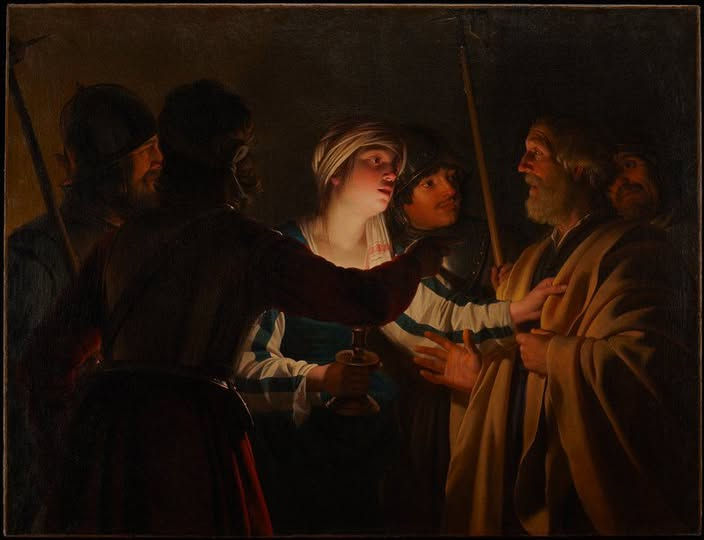
    Gerrit van Honthorst The Denial of St Peter c.1623

    Later, in Matthew 16, we see another pivotal moment. Jesus asks His disciples, “Who do people say that I am?” They offer various answers—“Some say John the Baptist, others Elijah, and still others Jeremiah or one of the prophets.” But those were just the rumors.

    Then Jesus asks the real question: “But who do you say I am?”

    That’s the question we all must answer. Who do you say Jesus is? Was He just a moral teacher? A historical figure? A religious symbol? Or is He truly the Son of God, the Messiah, the Lord of your life?

    Peter gives the right answer: “You are the Messiah, the Son of the living God.” But he didn’t arrive at that answer on his own. Jesus tells him, “Flesh and blood has not revealed this to you, but My Father in heaven.” This was spiritual revelation—truth planted in Peter’s heart by the Holy Spirit.

    Jesus then says:

    Matthew 16:18–19 (NKJV) 18 “And I also say to you that you are Peter, and on this rock I will build My church, and the gates of Hades shall not prevail against it. 19 And I will give you the keys of the kingdom of heaven, and whatever you bind on earth will be bound in heaven, and whatever you loose on earth will be loosed in heaven.”

    Fast forward to Luke 22—the Last Supper. Jesus gathers with His disciples and says:

    Luke 22:14–16 (NKJV) 14 “When the hour had come, He sat down, and the twelve apostles with Him. 15 Then He said to them, ‘With fervent desire I have desired to eat this Passover with you before I suffer; 16 for I say to you, I will no longer eat of it until it is fulfilled in the kingdom of God.’”

    Did Peter have any clue this would be their final meal with Jesus? Probably not. It likely felt like any other gathering—good food, strong fellowship. Then things took a turn. Jesus begins speaking about betrayal. The disciples argue about who it could be, then shift into a dispute about who among them is the greatest.

    And in the midst of this, Jesus turns to Peter and says, “Simon, Simon, Satan has asked to sift you like wheat. But I have prayed for you, that your faith may not fail.”

    Peter, with passion, declares, “Lord, I am ready to go with You, both to prison and to death!” But Jesus knows better. He replies, “Peter, before the rooster crows, you will deny three times that you know Me.”

    Later that night, Jesus is arrested. A mob, led by Judas, comes to seize Him. Chaos. Fear. Confusion.

    Peter follows, but from a distance. At the high priest’s courtyard, as Jesus is put on trial, Peter tries to stay unnoticed. He only wants to warm himself by the fire. But then, a servant girl recognizes him: “This man was with Him.”

    Peter says, “Woman, I do not know Him.”

    Later, someone else insists, “You’re one of them.”

    “Man, I am not!”

    About an hour passes, and another person says, “Surely this man was with Jesus—his accent gives him away.” According to Matthew’s Gospel, Peter begins cursing and swearing. “Man, I do not know what you’re talking about!”

    And then the rooster crowed.

    Peter remembered what Jesus had said. Overwhelmed with shame, he went outside and wept bitterly.

    Was Peter there at the crucifixion? The Gospels don’t clearly say. Maybe he was. Maybe he watched from a distance. But we do know this: he was heartbroken. The one he loved was dying, and he had denied even knowing Him.

    Could Peter ever forget the look Jesus gave him in that courtyard? The eyes of the one he had denied? The memory must have haunted him. But don’t forget Jesus’ words: “I have prayed for you, that your faith may not fail.” When the Son of God prays for you, your story doesn’t end in failure. Not because of your strength but because of His.

    Each person present that night had a part in the story. Some watched silently. Some mocked. Some betrayed. Some scattered. Some, like John, stayed by the cross. Jesus’ mother, Mary, was there too. Perhaps Mary, Martha, and Lazarus were among the crowd. Crucifixion was a public display of shame—a message to all: this is what happens to rebels. The more people watching, the better for Rome.

    And yet, even amid that shame and suffering, God’s purpose was unfolding.

    Judas, filled with remorse, took his own life. Peter, filled with grief, would later find forgiveness. Jesus was crucified, died, and was buried.

    This is what Good Friday is about—remembering the cross. This is the one day we pause, and we do not rush ahead to Easter Sunday. We leave Jesus on the cross, not because He’s still there, but to remember the cost.

    Many today wear crosses as jewelry but do not understand what it truly represents. The cross is not just a symbol of suffering—it is a call to discipleship. As William Penn wrote, “No Cross, No Crown.” Without enduring the cross, there is no hope for the crown.

    Luke 9:23–26 (NKJV) 23 “If anyone desires to come after Me, let him deny himself, and take up his cross daily, and follow Me. 24 For whoever desires to save his life will lose it, but whoever loses his life for My sake will save it. 25 For what profit is it to a man if he gains the whole world, and is himself destroyed or lost? 26 For whoever is ashamed of Me and My words, of him the Son of Man will be ashamed when He comes in His own glory…”

    There’s so much in that passage. But focus on this: “Take up your cross daily.” That means the cross is not distant, not abstract—it is personal. We each carry one. And in doing so, we walk the path Christ walked.

    Today, we remember His cross.

    Sermon: I Don’t’ Even Know the Man | March 29, 2024 Shubert Christian Church, Shubert, Nebraska / April 6, 2012 First Christian Church (DOC) Winfield, KS

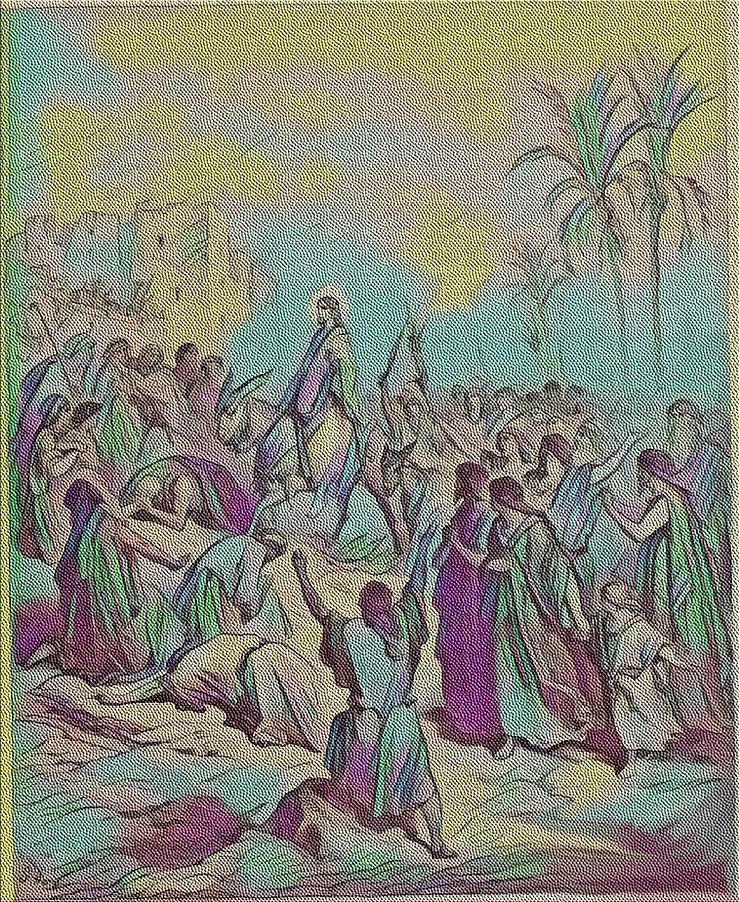
  • The Significance of “Hosanna” and The Triumphal Entry in Celebrating Palm Sunday

    As the Season of Lent comes to a close, we turn to Mark 11:1-11 (NKJV): 

    1 Now when they drew near Jerusalem, to Bethphage and Bethany, at the Mount of Olives, He sent two of His disciples; 2 and He said to them, “Go into the village opposite you; and as soon as you have entered it you will find a colt tied, on which no one has sat. Loose it and bring it. 3 “And if anyone says to you, ‘Why are you doing this?’ say, ‘The Lord has need of it,’ and immediately he will send it here.” 4 So they went their way, and found the colt tied by the door outside on the street, and they loosed it. 5 But some of those who stood there said to them, “What are you doing, loosing the colt?” 6 And they spoke to them just as Jesus had commanded. So they let them go. 7 Then they brought the colt to Jesus and threw their clothes on it, and He sat on it. 8 And many spread their clothes on the road, and others cut down leafy branches from the trees and spread them on the road. 9 Then those who went before and those who followed cried out, saying: 
    “Hosanna! 
    ‘Blessed is He who comes in the name of the Lord!’
    10 Blessed is the kingdom of our father David 
    That comes in the name of the Lord! 
    Hosanna in the highest!”
    11 And Jesus went into Jerusalem and into the temple. So when He had looked around at all things, as the hour was already late, He went out to Bethany with the twelve.

    Holy Week officially begins. The quiet time that we have spent in spiritual reflection is now interrupted with noise coming from the crowds. We hear voices crying, “Hosanna!  Hosanna!  Blessed is the One who comes in the name of the Lord.  Hosanna!  Hosanna!  Blessed is the coming kingdom of our father David!  Hosanna in the highest!”

    Depending on what particular study Bible you have, this event is more popularly labeled as “The Triumphal Entry.” We celebrate it as Palm Sunday, even though according to Mark’s gospel, there is no mention of palm branches. The description says “leafy branches.” The type of branches seems irrelevant. The focus here is on the act of worship.

    So, why is this entry considered triumphal? 

    Some people might wonder why this is called The Triumphal Entry. Considering the crucifixion of Jesus that takes place later, it is more of a triumph turned tragedy. The people cry out “Hosanna,” which means, “Save us,” or “Save now.” The act of saving would most certainly be expected, that is, if Jesus is the Messiah, the Christ of God.  And we believe that He is.

    But still, one has to have some appreciation for the dramatization done by Mark’s gospel.  Mark is a short gospel and does not offer a lengthy dissertation. The story shifts in Mark 10, with Jesus healing Blind Bartimaeus as he is approaching Jerusalem. The people who believe in Jesus are there to greet Him, offering shouts of praise, and some probably expecting Him to claim His rule as the Messiah.

    We know the gospel’s story.  Jesus does not claim any throne.  He gets arrested.  Jesus does not gain any high recognition or respect.  He gets mocked and ridiculed.  As I just referred to the dramatization of Mark’s story, the Hosanna cries quickly turn to cries of mourning.  Faith most surely turns to doubt, as the One who appears to be the Savior is unable to save Himself.

    Mark’s gospel gives a good account of the mockery that is said.   Mark 15.27-32 reads:

     27 Two criminals were crucified with him, their crosses on either side of his. 29 And the people passing by shouted abuse, shaking their heads in mockery. “Ha! Look at you now!” they yelled at him. “You can destroy the Temple and rebuild it in three days, can you? 30 Well then, save yourself and come down from the cross!”
    31 The leading priests and teachers of religious law also mocked Jesus. “He saved others,” they scoffed, “but he can’t save himself! 32 Let this Messiah, this king of Israel, come down from the cross so we can see it and believe him!” Even the two criminals who were being crucified with Jesus ridiculed him.

    When one examines the whole story that occurs from triumphal entry to crucifixion, it may be difficult for some people to see the triumph of the occasion.  On the other hand, it seems more of a failure on the people’s part to understand the true person Jesus was and what His mission was—what He came to do. 

    They were not seeing Jesus through the window of Isaiah 53.3-12:

    He was despised and rejected—a man of sorrows, acquainted with bitterest grief. We turned our backs on him and looked the other way when he went by. He was despised, and we did not care. 
    Yet it was our weaknesses he carried; it was our sorrows that weighed him down. And we thought his troubles were a punishment from God for his own sins! 5 But he was wounded and crushed for our sins. He was beaten that we might have peace. He was whipped, and we were healed! 6 All of us have strayed away like sheep. We have left God’s paths to follow our own. Yet the Lord laid on him the guilt and sins of us all.
    He was oppressed and treated harshly, yet he never said a word. He was led as a lamb to the slaughter. And as a sheep is silent before the shearers, he did not open his mouth. 8 From prison and trial they led him away to his death. But who among the people realized that he was dying for their sins—that he was suffering their punishment? He had done no wrong, and he never deceived anyone. But he was buried like a criminal; he was put in a rich man’s grave.
    10 But it was the Lord’s good plan to crush him and fill him with grief. Yet when his life is made an offering for sin, he will have a multitude of children, many heirs. He will enjoy a long life, and the Lord’s plan will prosper in his hands. 11 When he sees all that is accomplished by his anguish, he will be satisfied. And because of what he has experienced, my righteous servant will make it possible for many to be counted righteous, for he will bear all their sins. 12 I will give him the honors of one who is mighty and great, because he exposed himself to death. He was counted among those who were sinners. He bore the sins of many and interceded for sinners.

    We turn back to the question, why is this considered Triumphal? On the surface, it appears to be one of the great tragedies of all time.  If there had been the technology for newspapers, the headlines might have read: 

    RELIGIOUS RADICAL, PUBLIC MENACE, 

    EXECUTED BY THE ROMAN GOVERNMENT.

    Still, as one gains an understanding of what, or rather whom, Jesus came to save–then his entry was triumphal. We understand better that Jesus did not come into the world to become a political leader to liberate his people. Jesus came to seek and to save the lost. [Luke 19.10] Jesus came to save sinners. Jesus came to save all of the human race, past, present, and future, from death and destruction. Furthermore, we understand being saved as being allowed to live life with Jesus after we die.

    What has occurred then through the triumphal entry is the announcement of the greatest form of salvation. Had Jesus been a political ruler like King David, the people might have been content for a time under his rule. But what happens when the king dies? Another king comes to rule. In the history of the Old Testament, there were good kings and even more wicked kings. The people during Jesus’ time were living under the rule of wicked kings. Why would the world need another earthly king?

    But now the problem is solved. It no longer matters who the king reigning on the earth is.  There is now an appointed king who will rule for all of eternity.   This King who comes—comes in triumph—triumphal entry. 

    What does this mean for us today? Today, we have a wonderful privilege, to offer worship to the One who has saved us.  Today, we have the option to cry out “Hosanna,” and from the very moment we utter our cry, the Savior hears us. Did you ever think how easy it is to be saved? I am not talking about how easy it is to live the Christian life because living the Christian life is not easy.  But being saved is easy. Being saved is as easy as saying to Jesus Christ, “Hosanna—save me, Lord!”   

    Of course, what is equally important is that your cry comes from the depths of your heart.   It is like falling into a rapidly moving stream and being carried down the river. You realize that unless something miraculously happens, you are sure to drown. And then, as you grab hold of your senses, you know there is only one thing to do. You cry out as loud as you can, “Help…someone, save me!” Usually, those people standing safely on the side of the bank are not arguing amongst themselves, “Well, what do you think? Is that an earnest cry for help?” Maybe I am expecting too much here with my illustration.  

    In some places in this country, the reaction might be: 

    “I just don’t want to get involved!”  

    “If I go rescue that person crying for help—my luck they would hit their head on a rock in the process and then sue me for all I am worth.” 

    Then there are those people who say,

    “What? I can’t hear you! Do you need help?”

    “Too late; I guess they did not need my help.”  

    Still believing there is some goodness left in humanity, most will attempt to rescue a person who is drowning. With the same kind of reaction, Jesus is quick to rescue us.

    Romans 10.13:

    13 For “whoever calls on the name of the Lord shall be saved.”

    Considering the invitation, is there anyone who is drowning? Is there anyone who needs saving? It is our purpose to continue the ministry of Jesus Christ, to seek and to save the lost. We give an invitation to those who are seeking salvation, as well as those who are seeking a family of faith.

    Sermon: “Hosanna” | April 16, 2000, at FCC Paradise, California and April 5, 2009, FCC Winfield, KS

  • Exploring the Significance of Noah and the Ark in Genesis 6-12

    One of the more difficult stories in the Old Testament for people to accept as factual is the story of Noah and the Ark. In Genesis 6:5-8 (NKJV): 

    5 Then the LORD saw that the wickedness of man as great in the earth, and that every intent of the thoughts of his heart was only evil continually. 6 And the LORD was sorry that He had made man on the earth, and He was grieved in His heart. 7 So the LORD said, “I will destroy man whom I have created from the face of the earth, both man and beast, creeping thing and birds of the air, for I am sorry that I have made them. 8 But Noah found grace in the eyes of the LORD.

    Think about it. You have one man, one family, one large boat, two of every animal, and a rainstorm that causes the entire world to flood. It rains for forty days and forty nights. Most of us have seen it rain for several days in a row, maybe even forty days, and have never seen enough flooding to destroy the earth. 

    Some of the more modern Bible scholars have written the story off as merely an example of a Jewish fable. On the other hand, there have been rumors for the past four decades that someone has found Noah’s Ark, some even say on Mt. Ararat. Theories have been explained to show how the ark was once on top of the mountain, which is believed to be a volcano. The volcano erupted around a thousand years ago and carried the ark down through a flow of lava. 

    Most recently, archaeologists believe they have discovered the final location on Turkey’s Mount Ararat through soil samples which reveal human activity and marine materials during the time of the flood (dating around 5500 to 3000 BC). Yet, many researchers disagree and even disagree on the extent of the flood saying that “those events naturally made their way into the world’s oral and written lore.” Andrew A. Snelling, a geologist and Director of Research for Answers in Genesis says, “We do not expect the Ark to have survived and been available to find after 4,350 years.” 

    While such theories continue to exist, there is no credible archaeology done to prove that Noah’s Ark exists. However, there are people who desperately want to find it. Christians and Jews would most certainly rejoice if Noah’s Ark were found. 

    As a Bible story, we accept Noah and the Ark on faith, believing that because it is in the Bible, it has to be true. This story is not told in the form of a historical lesson. It’s an example of God’s salvific act. We are not left standing on the sidelines wondering why God, who is an all-loving God, would carry out this horrendous act of destroying His creation. Instead, we should be grieved as God was grieved seeing His creation only desiring to perform evil acts. This here is an example in the history of humanity where God’s heart was broken. 

    In Genesis 6:13-14, God proposes a plan: 

    13 And God said to Noah, “The end of all flesh has come before Me, for the earth is filled with violence through them; and behold, I will destroy them with the earth. 14 “Make yourself an ark…”

    The Bible gives the description and measurements in “cubits.” Modern comparisons describe the ark as being about half the size of an ocean liner, the Queen Elizabeth (which is about double the size of the Titanic), and about 450 feet long. Imagine if you took one of each animal from the face of the earth and placed it aboard the Queen Elizabeth. This glorious ship would still not be large enough to hold all the a animals. So, again, there are always people waiting to dispute what the Bible claims. 

    The Hebrew word, tebah (teebayh) is translated as “ark” from the Latin word “arca.” This translation is often debated, as well as the shape of the ark. Most Bible scholars agree the ark was shaped more like a chest or box-shaped but others believe it to be more of a “floating palace.” Clyde Francisco, a Bible scholar, says “it was certainly not built for sailing but for surviving.” What’s important to note is that there is value in seeing that God had a specific vehicle in mind by which to save Noah, his family, and the birds and animals. God could have placed them all on a raft, and yet still God could have saved them. 

    The fact is, this event occurred over 4,000 years ago. We do not have a methodology for a reconstruction of how this might have occurred. Some people feel comfortable writing this story off as fiction. But, if one reduces this story to be only a Jewish myth or fable, then does one really believe in God? 

    God does not seem the least concerned about coming forward to prove His ark existed. One can choose to believe or not believe. The basic synopsis stands: Noah was told to build an ark. Using this ark, God would establish his covenant with Noah. We now see a greater purpose to the Noah and the Ark story. It’s not only about a man, his family, some animals, and a flood. It is about God’s righteous judgment passed against all that is evil. It is about God’s wondrous grace given to save that which is good. And, with this, God was not merely saving a few people aboard an ark. He was saving a multitude of generations of people to follow. 

    In the Dickson study Bible, The New Analytical Bible (1973), Dickson states “Noah is the last member of the Sethite line of the Antediluvian Age. From Seth to Noah, nine members of that line are given. The race is to be all but obliterated, but it is not only preserved but also the Messianic line. It is of special interest that the preservation of the race is in the line of the Messiah, hence the history of a Savior will be fulfilled in the historical line that has been selected.”.

    Luke’s gospel traces the genealogy of Jesus all the way back through Noah in Noah 3:36-38 (NIV): 

    36 the son of Cainan, the son of Arphaxad, the son of Shem, the son of Noah, the son of Lamech, 37 the son of Methuselah, the son of Enoch, the son of Jared, the son of Mahalalel, the son of Kenan, 38 the son of Enosh, the son of Seth, the son of Adam, the son of God.

    In short, we see God’s plan of salvation extends to multiple generations–not limited to one. If people today were to take away the story of Noah and the Ark, then one is destroying one of the basic roots of God’s salvation plan. Furthermore, to not believe in Noah and the Ark is to not believe in God’s plan of salvation. Still, there is another reason we review this story. It’s to remind us that Noah and the Ark symbolize new beginnings. 

    Noah obeyed God. He built the ark. People probably laughed at him, “Hey, look at that old man, Noah, up there building an ark. Want us to come up and show you how to build a real boat, Noah?…Hey, Noah, where’s the flood…That’s quite the house you are building up there, Noah. You planning on having more kids? You’re crazy Noah!”

    Noah built the ark. He did everything God asked him to do. He loaded up the animals and his family. God shut the door and turned on the rain. It rained and rained. And all those people who had no vehicles for survival sank. They all drowned. 

    The rain stopped, but the waters continued to cover the earth for 150 days. Image by now, everyone was probably getting cabin fever. I mean, “Get those sheep over there some deodorant!” Noah started sending birds out to find land. Then, imagine the day when Noah and his family first stepped out of the ark. It is like an undiscovered country, a whole new world. It was a new beginning. A new opportunity to begin again. 

    Title: Noah and the Ark | Sermon: January 5, 2003, First Christian Church (Paradise, California)

  • Original Song: Mighty is the Lord Our God

    Might is the Lord Our God was written by Dennis Alan Fulbright in 1981 with Iris Green.

    {Opening Instrumental}

    Mighty is the Lord our God
    Mighty is the Lord our God
    Mighty to deliver, mighty to set free
    Mighty is the Lord our God

    Father You are mighty
    Father You’re so kind
    Father we adore You
    You renew our minds
    Father You are holy
    We give You all our praise
    We will keep on shouting
    Our Lord,  Jesus saves!

    {repeat both parts}

    Ending

    Mighty is the Lord our God
    Mighty is the Lord our God
    Mighty is the Lord our God

    {Closing Instrumental}

  • Uncovering the Dysfunction: A Deep Dive into the Family Dynamics of Genesis 3-5

    Not a day goes by in America where the political parties accuse each other of violating ethics. Some of the most common examples from today are the Republicans accusing Hunter Biden, son of President Joe Biden, of using his father’s position for personal gain when conducting business deals in Ukraine and China. The Republicans frequently accuse Hillary Clinton, former Secretary of State and Democratic presidential nominee, of misusing classified information in her private email server. 

    Of course, the Democrats aren’t off the hook either. The Democrats have criticized former President Donald Trump for various things ranging from conflicts of interest in business deals to mixing personal financial interests with presidential duties. Additionally, the Democrats have accused the Trump administration for a variety of ethical rules, including conflicts of interest, misuse of resources, and more. 

    The blame game isn’t just a part of our political government, it’s played in every area of society. From medical professionals denying they prescribed the wrong treatment, a teacher giving out answers for standardized tests, and even in the church, where they deny the responsibility for driving away a family; or even worse, driving someone away from the Kingdom of God. 

    With Adam vs. Eve or Adam and Eve vs. The Serpent, God held all parties accountable. In Genesis 3:8-9 (NIV), we read:

    8 Then the man and his wife heard the sound of the Lord God as he was walking in the garden in the cool of the day, and they hid from the Lord God among the trees of the garden. 9 But the Lord God called to the man, "Where are you?"

    This gives us an indication of what God’s judgment is like. If Adam would have said, “Father I have sinned,” or Eve would have said, “Father, I have sinned against you,” we might wonder how God may have responded. 

    Of course, the Serpent in the story was not going to admit it had sinned. But knowing who the Serpent is (from Revelation 20:2), he has a long history of being incapable of repenting. Still, God held all parties accountable and therefore, Adam and Eve were driven out of the garden (v. 24). 

    In Genesis 4, we learn that Adam and Eve went on to produce a family. (Genesis 4:1-2, NIV):

    Adam made love to his wife Eve, and she became pregnant and gave birth to Cain. She said, "With the help of the Lord, I have brought forth a man." 2 Later she gave birth to his brother Abel.

    They may have had high hopes for making a new start in life. Yet, the life they had come to be adjusted to would drastically change. Their sons, Cain and Abel, had grown up. Abel was a shepherd. Cain was a farmer. But something between them happened, we don’t know, and if we were to operate under today’s court system, we would have no evidence to prove that Cain was an abused child, which drove him to murder his brother. 

    Some might blame God for being too favorable towards Abel. But, it is difficult for us to judge God, because God had an awareness of the intentions of Cain’s heart–something we never have. We never know what lies within a person’s heart. Nevertheless, Cain was filled with a passion to commit murder. So, he schemed against his brother, Abel, luring him out to a field: 

    8 Cain attacked his brother Abel and killed him. 

    If they’d lived in the 20th century, the newspapers would have headlined:

     “Man Kills His Own Brother In a Violent Attack

     Parents Are Baffled at One Son Dead, The Other a Murderer”

    It was reported that sometime in the late afternoon, a father, Adam, went out to the fields to look for his sons. To his horror, he discovered his younger son lying out in the field, dead, lying in a pool of blood, and suffering from severe internal injuries. Going back to his local village, he reported the crime and discovered that his other son was in custody being tried for murder:

    Genesis 4:9 (NIV) “Then the Lord said to Cain, ‘Where is your brother Abel?’ / ‘I don’t know,’ he replied. ‘Am I my brother’s keeper?”

    Unlike his parents, when God confronted Cain, he didn’t cry out to God and say, “Oh Father, please have mercy upon me! I don’t know what came over me.” Instead, it was more of a smug statement, “Am I my brother’s keeper?” 

    There seems to be no Scriptural evidence at this point as to if Cain was truly sorry for the sins he committed. Again, under our laws, he would probably be given life without parole or possibly placed on death row. And while some may feel our God is unmerciful; God sentenced Cain to be banished from his homeland:  

    11 Now you are under a curse and driven from the ground, which opened its mouth to receive your brother’s blood from your hand. 12 When you work the ground, it will no longer yield its crops for you. You will be a restless wanderer on the earth.” 13 Cain said to the Lord, “My punishment is more than I can bear. 14 Today you are driving me from the land, and I will be hidden from your presence; I will be a restless wanderer on the earth, and whoever finds me will kill me.” (Genesis 4:11-14, NIV)

    Like Adam and Eve were thrown out of their home in the Garden, Cain was driven away from his home. And the lives of his family members remained changed forever. Adam, Eve, Cain, and Abel, were the people of God. God created his people in his own image (Genesis 1:27). Whereas today, we are God’s people. We are his creation. Yet, are we just as dysfunctional? 

    Maybe some of us have come from dysfunctional families. Those are families who have damaged their own members in some way. And then, once we have been damaged, at what point do we gain the ability to function again? 

    Some churches are like dysfunctional families. In particular, some have had drastic events that occur that cause a great amount of damage, and the damage continues to build on itself. Or, the problem may be there has been one person, or a small handful of people, who have operated under the spirit of Cain. They begin to develop a fit of jealousy that drives them to sin. Maybe not murder in the physical sense but certainly murder in the spiritual sense. And, then following the murder, they still will not own up that they have done any wrongdoing. They smooth it out and sweep any evidence under the rug. 

    We might wonder, how does one move on? Adam and Eve were able to move on. They had another child, Seth (Genesis 5:3-8): 

    3 When Adam had lived 130 years, he had a son in his own likeness, in his own image; and he named him Seth. 4 After Seth was born, Adam lived 800 years and had other sons and daughters. 5 Altogether, Adam lived a total of 930 years, and then he died.
    6 When Seth had lived 105 years, he became the father of Enosh. 7 After he became the father of Enosh, Seth lived 807 years and had other sons and daughters. 8 Altogether, Seth lived a total of 912 years, and then he died.

    There is always the hope of a new beginning. This hope has certainly kept the church alive and going for the past 2,000 years. If you know anything about church history, you must know that there have been many battles, and many disputes down through the ages. Furthermore, God has worked through and will continue to work through many people who have come from dysfunctional families. Each of us must commit our own life–that we are not going to be dysfunctional. And, that we will allow God’s Spirit to function in us and through us. 

    Title: A Dysfunctional Family | Sermon: January 5, 1997 / First Christian Church, LaJunta, Colorado

  • Exploring the Creative Spirit: How can we embrace our purpose as creators? (Genesis 1-2)

    26 Then God said, “Let us make man in Our image, according to Our likeness; let them have dominion over the fish of the sea, over the birds of the air, and over the cattle, over all the earth and over every creeping thing that creeps on the earth.” 27 So God created man in His own image; in the image of God He created him; male and female He created them. 28 Then God blessed them, and God said to them, “Be fruitful and multiply; fill the earth and subdue it; have dominion over the fish of the sea, over the birds of the air, and over every living thing that moves on the earth. (Genesis 1:26-28, NKJV)

    When looking at the text in Genesis 1, we see that God says, “Let us make man in Our image, according to Our likeness…” You might be thinking, “who is the ‘us’” in this scripture? Scholars today have interpreted this in various ways. Terence Fretheim, author of The New Interpreter’s Bible (1994) suggests God, along with a “divine realm” was responsible for this creative process and many scholars agree with him. However, others, like myself, would interpret the “us” as a reference to God, Christ, and the Holy Spirit. This is believed through interpreting the text from the Gospel of John: 

    1 In the beginning was the Word, and the Word was with God, and the Word was God. 2 He was in the beginning with God. 3 All things were made through Him, and without Him nothing was made that was made. (NKJV).

    This is interrupted to say that Christ was present before the world began and assisted in the process of creation. Assuming now that God, Christ, and the Holy Spirit are present in the creation of humankind, what seems equally important is that we were created in the image of God. 

    A whole area of theology has been devoted to the study of the “image of God,” where some scholars even throw around the term, imago Dei, which is Latin for “image of God.” Further, we know that there are several popular religions in the world that go beyond man being created in the “image of God,” to say that humanity will eventually become God. Of course, the idea that humankind will evolve to become a god is not Biblical, and is bothersome to traditional Christians. We are also repulsed by the suggested theory of evolution, because none of us want to see our God as a glorified ape-man. 

    To be created in the image of God is more interpreted as “likeness.” Man is not God, but is like God. Man “reflects the divine nature [of God] within his humanity. Man, mankind, womankind, humankind are created in the image and likeness of God. Whereas, one could probably spend a great deal of time and energy focusing on this idea and the multitude of ways our lives reflect the life of God, or Creator, and our Father. The main attribute, we have been created to create.” 

    When we think of creation, we think of artists. Artists are not merely those who paint or draw. Artists are people who create, compose, and write music. Artists are people who make designs that lead toward advanced technology. Artists may be the people who make quilts, who create delicious meals, and who put together lovely arrangements of flowers. Artists may be the mechanics who are gifted at fixing things or the carpenters who are gifted at building things. 

    Artists are equally as well people who create new methodologies for doing effective ministry. Mentioning the doings of effective ministry, leads into the frustration some pastors experience with the church today. This frustration is witnessing the church as a place that destroys creativity. 

    If humans were created in the image of God, we see quite plainly that we have been created to create. For most of us, we can quite plainly say at some point in our life: “I made that,” or “I created that!”

    Here is where the traditional churches destroy creativity. At one time there was creativity. Someone came up with an idea, or a program; it was tried; it was successful; and everyone liked it. But then, someone decided this is the way it has to be done and year after year, decade after decade, someone else would say “this year, let’s try doing this.” They were immediately cut down by a person or group of persons who proclaimed in unison: “This is the way we’ve always done it. This is the way it has to be done.” The biggest issue with this is that when people act this way toward another, we are not simply destroying creativity, we are killing the person God created them to be. 

    It’s almost like murder. God created us to create. He gifted us with creativity, and placed within us a burning desire to go forth and make accomplishments. Then, God started us down the road of creativity, he said “Be fruitful and multiply” (Genesis 28). Then, Jesus said in Mark 16:15 (NKJV): 

    15 Go into all the world and preach the gospel to every creature. 

    But, then someone decided if you’re going to preach the gospel, your sermon needs an introduction, three main points, and a conclusion. Someone decided the sermon would be delivered in a church building. A building with pews, a pulpit, a choir oft, an organ, and a piano. A church has have a narthex, a place for greeters and a guest book to sign. A church has to have a cross hanging on the wall, a baptistery, and a communion table. And on the communion table, there is a proper way of setting the table, and by golly, you’d never not goof that up. And, so with all this arrangement by which we call the church, if someone came up with a creative idea for change, we would say, “this is the way we’ve always done it. This is the way it has to be done.” 

    In Genesis 1:28 (NKJV), 28 Then God blessed the, and God said to them, “Be fruitful and multiply; fill the earth and subdue it; have dominion over the fish of the sea, over the birds of the air, and over every living thing that moves on the earth. 

    Mankind was given dominion over all the other creatures of the earth. Defining the word, dominion, we could also add power and authority. The creator has created a special creation, humankind, to create and have power and authority over the rest of God’s creation. 

    At one point in my ministry career, we lived in a parsonage in La Junta, Colorado. After living there a year, we discovered a terrible problem. We had an overpopulation of pigeons. These pigeons were terribly messy. They left droppings all over the roof, the sidewalks, our cars, and everywhere else. So when I sought out help, there was no Save the Pigeons society (that I was aware of). There was no one willing to relocate these pigeons to a more suitable environment. I called an exterminator and was informed with a hefty price, he would come and poison the pigeons with poisoned food. The drawback to that was that other birds might be poisoned in the process and the poison would only last for a time. 

    Being a person raised in a farming community, I instead elected to buy a BB gun and proceeded to have dominion over these pigeons. At the end of the year, the pigeon population was under control, as I had officiated over the funerals of at least nineteen pigeons that year. 

    Is this story a confession of my sins? Not really. I have no remorse over saying farewell to these pigeons. While I do like animals, I’m not an animal rights activist over pigeons. My faith will remain to believe that I am a special part of God’s creation – doing what I was called to do as part of the dominion, care, and authority of the human race. 

    In conclusion, it is our purpose to create! The ministries and the church should exist to inspire people to continue to create. Considering the great commission of taking the gospel into all the world, we need the creativity of the saints to invent new ways for getting the job done. God has assigned us all a gift, and he will hold us accountable for it. If we don’t use our creativity, God will see us as non-productive. Even worse, if we don’t use our creativity, we are going against what God has created us to be.  So, let’s commit ourselves to be all that we can be or our Lord. 

    Title: Formerly “Created to Create” | Sermon: March 23, 2003, First Christian Church Paradise, California