Mark

  • Faith That Can Make the Impossible Possible / Lent, Day 2 Mark 9

    Jesus Heals a Boy Possessed by an Impure Spirit
    14 When they came to the other disciples, they saw a large crowd around them and the teachers of the law arguing with them. 15 As soon as all the people saw Jesus, they were overwhelmed with wonder and ran to greet him.
    16 “What are you arguing with them about?” he asked.
    17 A man in the crowd answered, “Teacher, I brought you my son, who is possessed by a spirit that has robbed him of speech. 18 Whenever it seizes him, it throws him to the ground. He foams at the mouth, gnashes his teeth and becomes rigid. I asked your disciples to drive out the spirit, but they could not.”
    19 “You unbelieving generation,” Jesus replied, “how long shall I stay with you? How long shall I put up with you? Bring the boy to me.”
    20 So they brought him. When the spirit saw Jesus, it immediately threw the boy into a convulsion. He fell to the ground and rolled around, foaming at the mouth.
    21 Jesus asked the boy’s father, “How long has he been like this?”
    “From childhood,” he answered. 22 “It has often thrown him into fire or water to kill him. But if you can do anything, take pity on us and help us.”
    23 “‘If you can’?” said Jesus. “Everything is possible for one who believes.”
    24 Immediately the boy’s father exclaimed, “I do believe; help me overcome my unbelief!”
    25 When Jesus saw that a crowd was running to the scene, he rebuked the impure spirit. “You deaf and mute spirit,” he said, “I command you, come out of him and never enter him again.”
    26 The spirit shrieked, convulsed him violently and came out. The boy looked so much like a corpse that many said, “He’s dead.” 27 But Jesus took him by the hand and lifted him to his feet, and he stood up.
    28 After Jesus had gone indoors, his disciples asked him privately, “Why couldn’t we drive it out?”
    29 He replied, “This kind can come out only by prayer.[a]”


    In this story from the Gospel of Mark 9, everything looks hopeless. The disciples cannot help. The father cannot control or protect his son. The problem has gone on for years. The boy is tormented by an unclean spirit that throws him to the ground, causes convulsions, and leaves him suffering. It is a picture of helplessness and a lack of faith.
    In verse 19, Jesus says, “O faithless generation.” He sees something deeper than the illness. He sees a lack of faith. The father’s own distressed words reveal it, “if You can do anything, have compassion on us and help us.”
    Jesus responds, “If you can believe, all things are possible to him who believes.”

    Your Faith Can Make the Impossible Possible

    Every day we face many hopeless situations, obstacles, and challenges. We are faced with sickness, disease, and injuries. Our lives are filled with worries and stress where many people are working 2-3 jobs just to make ends meet. Why does life have to be so tough?

    The season of Lent invites us to sit honestly in this tension. Lent is not a season of pretending we are strong. It is a season of confession.

    We live in a world shaped by the words of Genesis 3:19: “In the sweat of your face you shall eat bread… for dust you are, and to dust you shall return.” Life is hard. Bodies break down. Work exhausts us. Money feels unstable. Relationships strain. Stress presses in from every direction.

    We worry about sickness. We worry about bills. We worry about our children. We worry about the future. We try to secure ourselves with investments, careers, plans, and routines. Yet Jesus reminds us in Gospel of Matthew 6:19–20 not to store up treasures on earth, where everything can be stolen or destroyed. And in Gospel of John 10:10 He says He came to give life abundantly.

    Lent pulls back the curtain and asks: What are we really trusting?

    “Lord, I Believe; Help My Unbelief”

    The father in Mark’s Gospel is painfully honest. He does not pretend to have great faith. He cries out, “Lord, I believe; help my unbelief!”

    Faith is not pretending everything is fine. Faith is bringing our fear, our doubt, and our weakness to Jesus and asking Him to strengthen what is fragile.

    So how do we cope when life feels impossible?

    We hold fast to God’s promises.

    Hebrews 10:23 tells us, “Let us hold fast the confession of our hope without wavering, for He who promised is faithful.”

    Peter 3:9 reminds us that the Lord is faithful and patient, not wanting any to perish.

    God keeps His promises. The question is whether we know His word well enough to cling to it.

    Book of Proverbs 4:20–22 urges us to pay attention to God’s words, to keep them in our hearts, because they are life and health to those who find them. During Lent, we slow down and return to Scripture. We fast from distractions so we can feast on truth.

    A Call to Believe Again

    The deeper problem in Mark 9 may not have been only the father’s weak faith. Jesus speaks of a “faithless generation.” Sometimes the greater danger is not open suffering but quiet unbelief. Churches can be full of people who go through the motions yet they hesitate to truly trust God.

    Lent challenges that comfort. It calls us to repentance. It calls us to renewed belief.

    In every hopeless situation, the invitation is the same; come to Jesus and believe. Not perfectly. Not proudly. But honestly.

    “Lord, I believe; help my unbelief.”

    Believing does not deny the sweat, the struggle, or the dust of Genesis 3. It trusts that beyond the cross stands resurrection. Lent moves us toward that hope.

    Jesus said, “All things are possible to him who believes.”

    In this season, we ask Him to do the impossible in our hearts. To turn our weak faith into steadfast trust, despair into hope, and hearts of dust into hearts alive with resurrection promise.

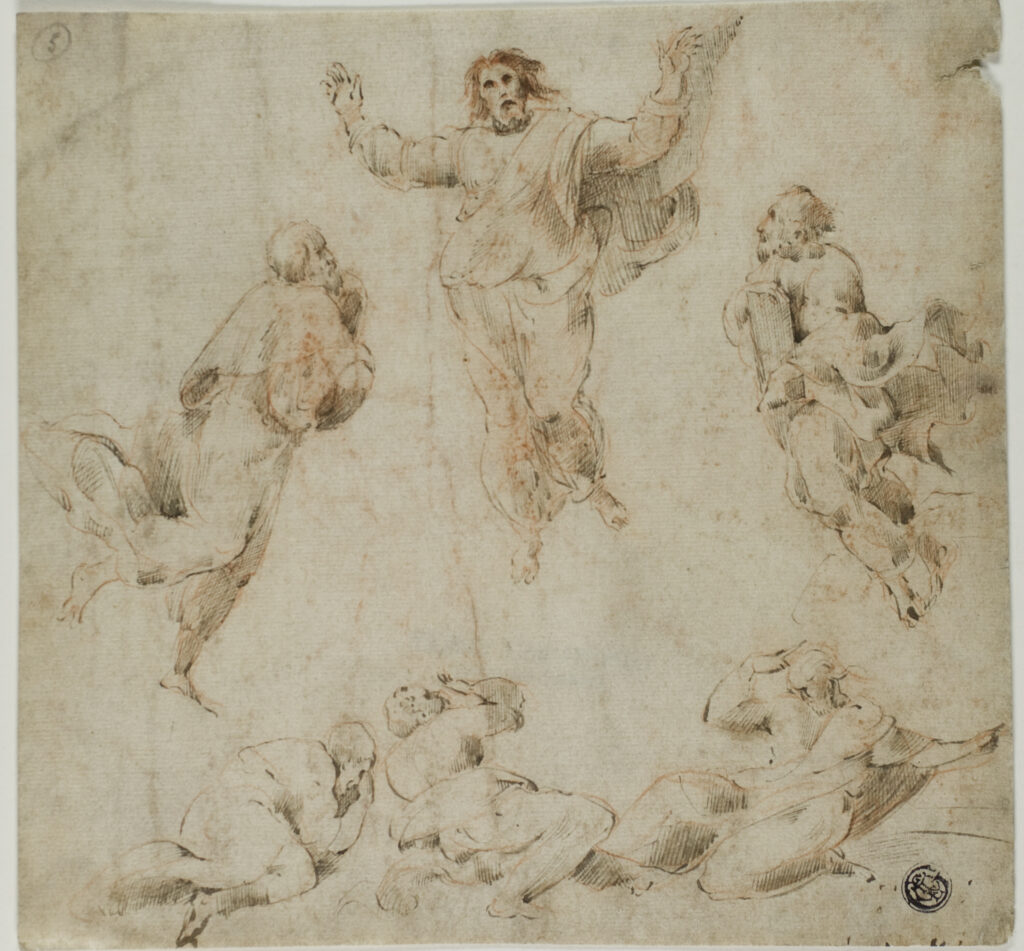
    Image caption: Transfiguration, 1530, Raphael, artic.edu/artworks/95792/transfiguration

    Adapted from Rev. Dr. Dennis Alan Fulbright’s Sermon, 2012.
  • The Significance of “Hosanna” and The Triumphal Entry in Celebrating Palm Sunday

    As the Season of Lent comes to a close, we turn to Mark 11:1-11 (NKJV): 

    1 Now when they drew near Jerusalem, to Bethphage and Bethany, at the Mount of Olives, He sent two of His disciples; 2 and He said to them, “Go into the village opposite you; and as soon as you have entered it you will find a colt tied, on which no one has sat. Loose it and bring it. 3 “And if anyone says to you, ‘Why are you doing this?’ say, ‘The Lord has need of it,’ and immediately he will send it here.” 4 So they went their way, and found the colt tied by the door outside on the street, and they loosed it. 5 But some of those who stood there said to them, “What are you doing, loosing the colt?” 6 And they spoke to them just as Jesus had commanded. So they let them go. 7 Then they brought the colt to Jesus and threw their clothes on it, and He sat on it. 8 And many spread their clothes on the road, and others cut down leafy branches from the trees and spread them on the road. 9 Then those who went before and those who followed cried out, saying: 
    “Hosanna! 
    ‘Blessed is He who comes in the name of the Lord!’
    10 Blessed is the kingdom of our father David 
    That comes in the name of the Lord! 
    Hosanna in the highest!”
    11 And Jesus went into Jerusalem and into the temple. So when He had looked around at all things, as the hour was already late, He went out to Bethany with the twelve.

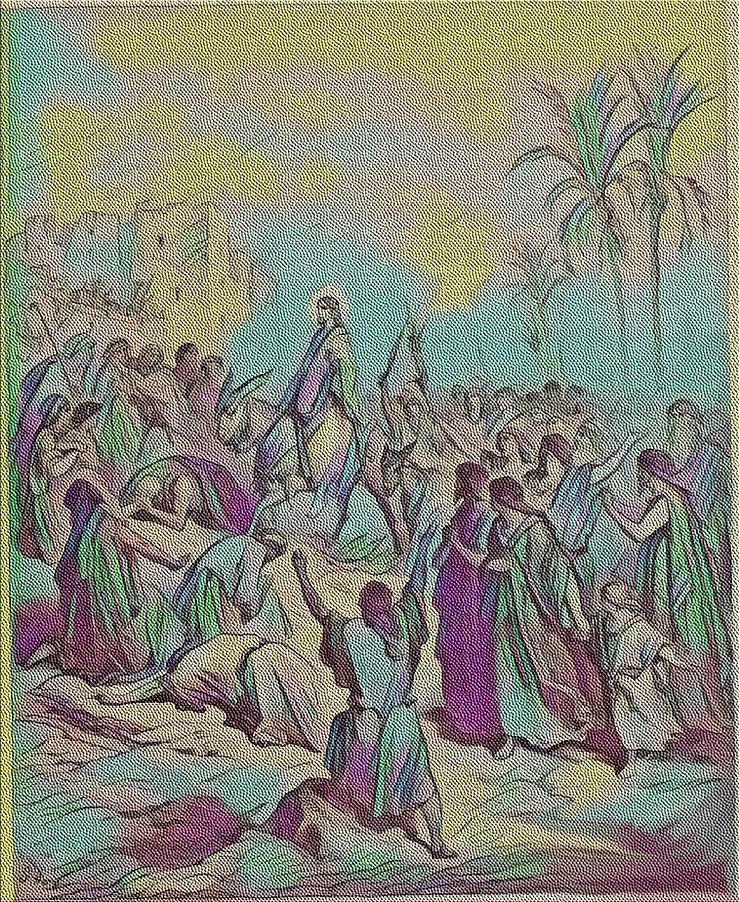
    Holy Week officially begins. The quiet time that we have spent in spiritual reflection is now interrupted with noise coming from the crowds. We hear voices crying, “Hosanna!  Hosanna!  Blessed is the One who comes in the name of the Lord.  Hosanna!  Hosanna!  Blessed is the coming kingdom of our father David!  Hosanna in the highest!”

    Depending on what particular study Bible you have, this event is more popularly labeled as “The Triumphal Entry.” We celebrate it as Palm Sunday, even though according to Mark’s gospel, there is no mention of palm branches. The description says “leafy branches.” The type of branches seems irrelevant. The focus here is on the act of worship.

    So, why is this entry considered triumphal? 

    Some people might wonder why this is called The Triumphal Entry. Considering the crucifixion of Jesus that takes place later, it is more of a triumph turned tragedy. The people cry out “Hosanna,” which means, “Save us,” or “Save now.” The act of saving would most certainly be expected, that is, if Jesus is the Messiah, the Christ of God.  And we believe that He is.

    But still, one has to have some appreciation for the dramatization done by Mark’s gospel.  Mark is a short gospel and does not offer a lengthy dissertation. The story shifts in Mark 10, with Jesus healing Blind Bartimaeus as he is approaching Jerusalem. The people who believe in Jesus are there to greet Him, offering shouts of praise, and some probably expecting Him to claim His rule as the Messiah.

    We know the gospel’s story.  Jesus does not claim any throne.  He gets arrested.  Jesus does not gain any high recognition or respect.  He gets mocked and ridiculed.  As I just referred to the dramatization of Mark’s story, the Hosanna cries quickly turn to cries of mourning.  Faith most surely turns to doubt, as the One who appears to be the Savior is unable to save Himself.

    Mark’s gospel gives a good account of the mockery that is said.   Mark 15.27-32 reads:

     27 Two criminals were crucified with him, their crosses on either side of his. 29 And the people passing by shouted abuse, shaking their heads in mockery. “Ha! Look at you now!” they yelled at him. “You can destroy the Temple and rebuild it in three days, can you? 30 Well then, save yourself and come down from the cross!”
    31 The leading priests and teachers of religious law also mocked Jesus. “He saved others,” they scoffed, “but he can’t save himself! 32 Let this Messiah, this king of Israel, come down from the cross so we can see it and believe him!” Even the two criminals who were being crucified with Jesus ridiculed him.

    When one examines the whole story that occurs from triumphal entry to crucifixion, it may be difficult for some people to see the triumph of the occasion.  On the other hand, it seems more of a failure on the people’s part to understand the true person Jesus was and what His mission was—what He came to do. 

    They were not seeing Jesus through the window of Isaiah 53.3-12:

    He was despised and rejected—a man of sorrows, acquainted with bitterest grief. We turned our backs on him and looked the other way when he went by. He was despised, and we did not care. 
    Yet it was our weaknesses he carried; it was our sorrows that weighed him down. And we thought his troubles were a punishment from God for his own sins! 5 But he was wounded and crushed for our sins. He was beaten that we might have peace. He was whipped, and we were healed! 6 All of us have strayed away like sheep. We have left God’s paths to follow our own. Yet the Lord laid on him the guilt and sins of us all.
    He was oppressed and treated harshly, yet he never said a word. He was led as a lamb to the slaughter. And as a sheep is silent before the shearers, he did not open his mouth. 8 From prison and trial they led him away to his death. But who among the people realized that he was dying for their sins—that he was suffering their punishment? He had done no wrong, and he never deceived anyone. But he was buried like a criminal; he was put in a rich man’s grave.
    10 But it was the Lord’s good plan to crush him and fill him with grief. Yet when his life is made an offering for sin, he will have a multitude of children, many heirs. He will enjoy a long life, and the Lord’s plan will prosper in his hands. 11 When he sees all that is accomplished by his anguish, he will be satisfied. And because of what he has experienced, my righteous servant will make it possible for many to be counted righteous, for he will bear all their sins. 12 I will give him the honors of one who is mighty and great, because he exposed himself to death. He was counted among those who were sinners. He bore the sins of many and interceded for sinners.

    We turn back to the question, why is this considered Triumphal? On the surface, it appears to be one of the great tragedies of all time.  If there had been the technology for newspapers, the headlines might have read: 

    RELIGIOUS RADICAL, PUBLIC MENACE, 

    EXECUTED BY THE ROMAN GOVERNMENT.

    Still, as one gains an understanding of what, or rather whom, Jesus came to save–then his entry was triumphal. We understand better that Jesus did not come into the world to become a political leader to liberate his people. Jesus came to seek and to save the lost. [Luke 19.10] Jesus came to save sinners. Jesus came to save all of the human race, past, present, and future, from death and destruction. Furthermore, we understand being saved as being allowed to live life with Jesus after we die.

    What has occurred then through the triumphal entry is the announcement of the greatest form of salvation. Had Jesus been a political ruler like King David, the people might have been content for a time under his rule. But what happens when the king dies? Another king comes to rule. In the history of the Old Testament, there were good kings and even more wicked kings. The people during Jesus’ time were living under the rule of wicked kings. Why would the world need another earthly king?

    But now the problem is solved. It no longer matters who the king reigning on the earth is.  There is now an appointed king who will rule for all of eternity.   This King who comes—comes in triumph—triumphal entry. 

    What does this mean for us today? Today, we have a wonderful privilege, to offer worship to the One who has saved us.  Today, we have the option to cry out “Hosanna,” and from the very moment we utter our cry, the Savior hears us. Did you ever think how easy it is to be saved? I am not talking about how easy it is to live the Christian life because living the Christian life is not easy.  But being saved is easy. Being saved is as easy as saying to Jesus Christ, “Hosanna—save me, Lord!”   

    Of course, what is equally important is that your cry comes from the depths of your heart.   It is like falling into a rapidly moving stream and being carried down the river. You realize that unless something miraculously happens, you are sure to drown. And then, as you grab hold of your senses, you know there is only one thing to do. You cry out as loud as you can, “Help…someone, save me!” Usually, those people standing safely on the side of the bank are not arguing amongst themselves, “Well, what do you think? Is that an earnest cry for help?” Maybe I am expecting too much here with my illustration.  

    In some places in this country, the reaction might be: 

    “I just don’t want to get involved!”  

    “If I go rescue that person crying for help—my luck they would hit their head on a rock in the process and then sue me for all I am worth.” 

    Then there are those people who say,

    “What? I can’t hear you! Do you need help?”

    “Too late; I guess they did not need my help.”  

    Still believing there is some goodness left in humanity, most will attempt to rescue a person who is drowning. With the same kind of reaction, Jesus is quick to rescue us.

    Romans 10.13:

    13 For “whoever calls on the name of the Lord shall be saved.”

    Considering the invitation, is there anyone who is drowning? Is there anyone who needs saving? It is our purpose to continue the ministry of Jesus Christ, to seek and to save the lost. We give an invitation to those who are seeking salvation, as well as those who are seeking a family of faith.

    Sermon: “Hosanna” | April 16, 2000, at FCC Paradise, California and April 5, 2009, FCC Winfield, KS