Psalm

  • Have Mercy On Me Lord | Ash Wednesday, Psalm 51

    Psalm 51:1–11 (NKJV) 
    1 Have mercy upon me, O God, 
    According to Your loving kindness; 
    According to the multitude of Your tender mercies, 
    Blot out my transgressions. 
    
    2 Wash me thoroughly from my iniquity, 
    And cleanse me from my sin. 
    
    3 For I acknowledge my transgressions, 
    And my sin is always before me. 
    
    4 Against You, You only, have I sinned, 
    And done this evil in Your sight— 
    That You may be found just when You speak, 
    And blameless when You judge. 
    
    5 Behold, I was brought forth in iniquity, 
    And in sin my mother conceived me. 
    
    6 Behold, You desire truth in the inward parts, 
    And in the hidden part You will make me to know wisdom. 
    
    7 Purge me with hyssop, and I shall be clean; 
    Wash me, and I shall be whiter than snow. 
    
    8 Make me hear joy and gladness, 
    That the bones You have broken may rejoice. 
    
    9 Hide Your face from my sins, 
    And blot out all my iniquities. 
    
    10 Create in me a clean heart, O God, 
    And renew a steadfast spirit within me. 
    
    11 Do not cast me away from Your presence, 
    And do not take Your Holy Spirit from me. 

    Psalm 51 is labeled: A Prayer of Repentance.

    This is a Psalm of King David (around 1000 BC) after the prophet Nathan confronted him for committing adultery with Bathsheba and arranging to have Bathsheba’s husband, Uriah the Hittite, to be killed in battle (instructing his soldiers to abandon Uriah while he was on the front lines) in order to cover up her pregnancy.

    Then it happened one evening that David arose from his bed and walked on the roof of the king’s house. And from the roof he saw a woman bathing, and the woman was very beautiful to behold. So David sent and inquired about the woman. And someone said, “Is this not Bathsheba, the daughter of Eliam, the wife of Uriah the Hittite?” Then David sent messengers, and took her; and she came to him, and he lay with her, for she was cleansed from her impurity; and she returned to her house. And the woman conceived; so she sent and told David, and said, “I am with child.” (2 Samuel 12:2-5, KJV)

    You are probably familiar with the saying, “Be sure your sins will find you out.” (Numbers 32:23)  That happened to David. He was caught. He was confronted. He could have followed after his predecessor King Saul.  Ignore God and do your own thing.  Live your life by your own rules.

    But David repented.

    He cries out (Psalm 51:1-9):  Have mercy upon me, O God…Blot out my transgressions. Wash me thoroughly from my iniquity, And cleanse me from my sin…I acknowledge my transgressions, And my sin is always before me. Against You, You only, have I sinned, And done this evil in Your sight… Wash me, and I shall be whiter than snow… blot out all my iniquities.

    David Provides a Model for True Repentance

    We do not know how many times King David sinned. We do not know how many times he committed similar sins in his lifetime. Was his cry for mercy a one-time event? Or, did he continually pray to God for forgiveness?

    What we do know it God’s Mercy is a Mystery.

    Not to be doubtful toward God in any way, but how many or how much of my sins will His mercy cover? God knows my heart. God watches over my life. God knows every time I sin and even my premeditated sins. God knows when those sins keep me from communicating with him. God knows when I am most vulnerable to sin. God knows my heart completely.

    People and even some Christians live their lives as if God doesn’t exist.  Yet God knows us even better than we know ourselves.

    How well do we know another person?

    People only know of us what we chose to reveal to them. That is one thing that makes life scary. The possibility that one may house hidden secrets. Even more scary that those hidden secrets create harm to another person(s).

    But with God there are no hidden secrets.

    Jesus said:  Luke 12:2 (NKJV) For there is nothing covered that will not be revealed, nor hidden that will not be known

    So, I live my life knowing that God knows everything about me—as God does each of you. 

    Where does God’s mercy kick in?

    We live in a sinful world where we are exposed to sin every moment of the day. Not just our own sins but the sins of those around us. We read about sins every day in the news. We see people sin, without remorse, in today’s social media, gossip columns, and celebrity lifestyles. Many of today’s news (especially celebrity news) focuses on who’s in a relationship with who, or “who’s sleeping with who?”

    And while the world sits on the edge of the seat absorbing this “gossip,” it’s not likely these sins will be remembered in the way that we remember King David’s sin. For one, King David’s sin wasn’t kept secret but imagine having committed a sin only for it to be documented in the best selling book of all time and read by millions of people for over 3,000 years. As long as the Holy Bible remains in print, people will continue to read about David’s sin. Whereas, the “published” articles and media we see about other’s sinful acts in today’s news…well, lucky for them, “yesterday’s news is today’s wastepaper” (Notting Hill).

    And while we might publish thosands of news articles about the sinful acts of others, it’s unlikely that another text will be published at the level of the Holy Bible. Celebrity’s can rest assured, their sins won’t be printed to last 3,000 years in the future. The main reason, there are just too many people committing the same sins at the

    Conclusion

    Psalm 51 is an example for repentance, showing David’s transition from a sinner attempting to hid his actions to a broken king seeking God’s restoration. The psalm reflects that while Nathan declared God had forgiven him, the king still felt the weight of his sin upon his shoulders.

    Psalm 51 is an “iconic” scripture for Ash Wednesday because it provides the ultimate biblical template for repentance and spiritual renewal. During this 40-day journey of self-examination, we use this psalm to set the pace for this season through the following connections:

    • Repentance: Psalm 51 is one of the seven Penitential Psalms and emphasizes a “broken spirit” and a “contrite heart” as the only sacrifices truly acceptable to God.
    • Reminder: We start this season with Ash Wednesday. The ash reminding us we are “dust,” symbolizing human frailty and the need for God’s “abundant mercy” to blot out transgressions.
    • Renewal: Psalm 51:10, Create in me a clean heart, O God” is a prayer many of us have said during this season. This verse uses the Hebrew word bārā’ (to create), the same word used in Genesis for God creating the world, which suggests only a divine act can provide the fresh start needed for Lent.

    We are reminded all throughout the Psalms of God’s everlasting loving kindness, love, and mercy that endures forever. We can be sure of God’s mercy as long as we are willing to repent with a sincere heart.  To assure us of a sincere heart we keep in our prayers the words of David, Psalm 51:10-11:
    10 Create in me a clean heart, O God, 
    And renew a steadfast spirit within me. 
    11 Do not cast me away from Your presence, 
    And do not take Your Holy Spirit from me.

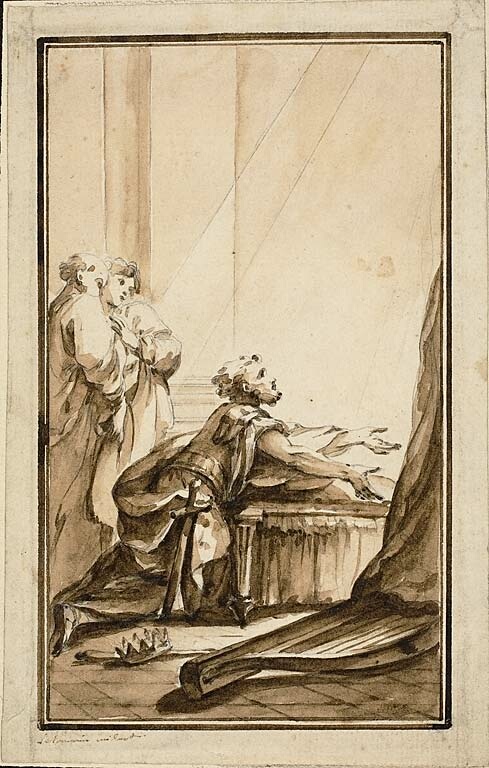
    Cover photo citation: Louis Joseph le Lorrain, 1715-1759, “King David Kneeling in Penitence,” George F. Porter Collection. https://www.artic.edu/artworks/34668/king-david-kneeling-in-penitence

    Adapted from Rev. Dr. Dennis Alan RobertsFulbright, 2014.

  • A Lifestyle of Thanksgiving | Deuteronomy 26:1–11 Sermon on Gratitude and Giving

    Deuteronomy 26:1-11 "When you arrive in the land of the LORD your God is giving you as a special possession and you have conquered it and settled there, 2 put some of the first produce from each harvest into a basket and bring it to the place the LORD your God chooses for his name to be honored. 3 Go to the priest in charge at that time and say to him, 'with this gift I acknowledge that the LORD your GOd has brought me into the land he swore to give our ancestors.' 4 The priest will then take the basket from your hand and set it before the altar of the LORD your God. 5 You must then say in the presence of the LORD your God, 'my ancestor Jacob was a wandering Aramean who went to live in Egypt. His family was few in number, but in Egypt they became a mighty and numerous nation. 6 When the Egyptians mistreated and humiliated us by making us their slaves, 7 we cried out to the LORD, the GOd of our ancestors. He heard us and saw our hardship, toil, and oppression. 8 So the LORD brought us out of Egypt with amazing power, overwhelming terror, and miraculous signs and wonders. 9 He brought us to this place and gave us this land flowing with milk and honey! 10 And now, our LORD, I have brought you a token of the first crops you have given me from the ground.' Then place the produce before the LORD your God and worship him. 11 Afterward go and celebrate because of all the good things the LORD your God has given to you and your household. Remember to include the Levites and the foreigners living among you in the celebration. 

    This passage from Deuteronomy describes the Israelites’ entry into the Promised Land as they took possession of the land they were permitted to farm. Once the crops were harvested, the Israelites were required to take some of the “first produce” (NLT) or “firstfruits” (NIV) and present it to the Lord in a worshipful ceremony. This ceremony consisted of a public acknowledgment, made to God, for all He had done for them. This wasn’t meant to be a small ‘thank you” for how does one offer a simple “thank you” to God who had provided so much. 

    This event has been repeated again and again, as men and women have entered new countries. As one has a consciousness of a higher power in existence, one realizes that God has done so much for humanity through many generations. And, for the most part, it is a tradition to say “thanks” to God for what he has done. 

    But, how does one express thankfulness? 

    In today’s fast-paced society, we fail miserably at saying “thank you” to people who deserve to be thanked. For some of us, we genuinely are thankful and know we need to express our gratitude, but time gets away from us, and before we know it, we believe too much time has passed, and our expression of thanks is too late. 

    Many of us have experienced this from both sides. We might have received something and failed to show gratitude for it. Or, we may have done something for someone or given them something, only to sit back and wait for those two simple words that will never come. We know that as each day passes, the hurt gouges deeper, and we realize that our awaited “thank you” has fallen into the sea of forgetfulness. Unfortunately for many, these feelings turn into bitterness as we promise to never do anything for that person again or never do or give again. 

    In our American culture, we have a designated holiday, Thanksgiving, for which we express our gratitude. Yet, even with one day set aside, we still manage to get caught up in the commercialized fog between Halloween and Christmas with the voice of Halloween hollering, “Give me treats!” and the voice of Christmas yelling, “Give me presents!” It’s easier to ignore the quiet voice of Thanksgiving as it reminds us to “give thanks.” Especially since big corporations can’t easily capitalize on and commercialize it. 

    What does it take to be thankful? 

    For Israel, it certainly could not be captured in one moment. There were no big screens blasting a casual “thank you God” commercial. No, for the Israelites, it was more about the lifestyle of thanksgiving. It was a tradition of giving thanks to God. It was part of their every day acts of faith that they would do over and over, say again and again, and out of this rich tradition, they would compose their words of thanks: 

    Psalm 107:1-9 1 Give thanks to the LORD, for he is good! 
    His faithful love endures forever. 
    2 Has the LORD redeemed you? Then speak out! 
    Tell others he has saved you from your enemies. 
    3 For he has gathered the exiles from many lands, 
    from east and west, from north and south. 
    4 Some wandered in the desert, 
    lost and homeless. 
    5 Hungry and thirsty, 
    they nearly died. 
    6 "LORD, help! they cried in their trouble,
    and he rescued them from their distress. 
    7 He led them straight to safety, 

    to a city where they could live. 
    8 Let them praise the LORD for his great love
    and for all his wonderful deeds to them. 
    9 For he satisfies the thirsty

    and fills the hungry with good things. 

    What should be our praxis? (Praxis = Established Custom)

    The gospel of John describes Jesus as very blunt. At one point, Jesus turned to the crowd and directly said, “I tell you the truth, you are looking for me, not because you saw miraculous signs but because you ate the loaves and had your fill.” (John 6:26, NIV). The basic principle here is this…If you want good church attendance, offer a meal afterward. If you want to attract young people, have a pizza party!

    All jokes aside, Jesus most certainly pointed out that He had a following of people who liked to eat. Furthermore, it may have been customary for great prophets to feed their people. Remember, when God fed Moses’ people in the wilderness (Exodus 16)? 

    But, Jesus pointed out (regarding Moses), “I tell you the truth, it is not Moses who has given you the bread from heaven, but it is my Father who gives you the true bread from heaven. For the bread of God is he who comes down from heaven and gives life to the world.” (John 6:32-33, NIV). 

    Again, we are reminded to thank God. 

    We turn back to the concept of Thanksgiving with this question: Do we only celebrate Thanksgiving because of the food? Not necessarily!

    Thanksgiving is THANKS
    followed by GIVING. 

    It really has little to do with a day for gluttony and more to do with a way of life. We receive from God, we give back to God. We receive again, we give again. We are thankful, and therefore we express our thankfulness by giving to others who are less fortunate or who are in need. Thanksgiving; thanks followed by giving is a wonderful opportunity. One can look up to heaven, offering up a heartfelt expression of thanks to God. We can realize and recognize God as the ultimate provider. We can give because we are blessed, and therefore, we are truly thankful. In this state of thankfulness, one truly receives the fullness of God’s blessings. Let us give thanks to God, continually! 

    Amen! 

  • Be Thankful, Be Present, Be His: The Call of Psalm 100

    We have reached the month of November—the month of no shaving, no spending, and NaNoWriMo (National Novel Writing Month). We are also reaching the start of the holidays, and this year will be the hardest yet. To make this holiday somewhat bearable, I wanted to search through Dr. DARFs sermons, which focus on gratitude, just in time for the Thanksgiving season. 

    Chris Tomlin – Psalm 100 (Lyrics & Chords)

    So, we turn to Psalm 100 (NKJV): A Song of Praise for the LORD’s Faithfulness to His People:

    A Psalm of Thanksgiving.
    1 Make a joyful shout to the Lord,
    all you lands!
    2 Serve the Lord with gladness;
    Come before his presence
    with singing.
    3 Know that the Lord, He is God;
    It is He who has made us, and not we
    ourselves, We are His people
    and the sheep of His pasture.
    4 Enter into His gates with thanksgiving.
    And into His courts with praise.
    Be thankful to Him, and
    bless His name.
    5 For the Lord is good;
    His mercy is everlasting, And His truth
    endures to all generations.

    Within the context of this Psalm is a principle, “or a key to a successful spiritual life…” and that “entering into God’s presence by means of dynamic praise, which includes singing, gladness, thanksgiving, and worship,” (Hayford 1997). Entering into God’s presence is important and needs to be emphasized. 

    How often do you walk through the doors of the church and think, I mean, intentionally think, about entering into God’s presence? And, when you get up to leave and go through those same church doors, what will be your testimony? Will it be: I entered into God’s presence today! Or, do you find yourself sometimes saying…” Well, I went to church this morning.” 

    Many don’t seem to think it’s all that important to attend church. If they did, our church pews would be fuller. A common excuse is “we just don’t get a whole lot out of it.” But what we are expecting is not what we should be expecting. 

    What are we expecting? 

    Here’s a general idea of what most expect – church is: 

    • A meeting hall for do-gooders
    • An institution that hosts multiple programs to meet the needs of everyone, while at the same time operating on little to no money
    • A home for a type of blood-sucking creature that rises up out of the dark abyss
    • A peaceful, decorative place for performing weddings and funerals
    • A life insurance company, after all, if you’re a member of a church, your life will be guaranteed to live in the hereafter

    To many, the church is a social organization. We gather here to socialize. We show up early to join our friends for coffee. But we rarely socialize with God.

    Returning to Psalm 100, James Smith (1996) points out that this is the only Psalm designated as a “psalm of thanksgiving.” This is not to be confused with the American tradition, Thanksgiving, but as an ancient practice of gratitude. We can assume this was once sung to an ancient community in Israel, and it is likely that people were very excited in their worship, much like charismatic people are today, not like liturgical mainline church attenders. 

    The Psalmist was called out to the people to come into the presence of the Lord. “Shout for joy to the LORD, all the earth. Worship the LORD with gladness.” 

    He may have asked them, “are you happy about being here today?”

    Then, he says “come before him with joyful songs. Known that the LORD is God! There certainly is no other God, it is he-the One God, who made us and we are his; we are the people, the sheep of his pasture.”

    We “enter his gates with thanksgiving,” which refers to the literal gates that ancient worshippers passed through when entering the temple courts. So, using a modern application – how did you enter the sanctuary this morning? Did you have praise on your lips? Were you thankful in your heart? 

    Maybe we have taken the church for granted for too long, assuming the church is always going to be here. Of course, the church will endure, but it may not always be readily available. In the same way, The Hebrews, or Jews have assumed their Temple would always be; guess again. They would now like to rebuild their temple, but there rests a pagan temple on top of their site.

    The point…we need to be thankful and we need to be thankful we have a God. This brings the traditional theme of this month: Thanksgiving. We associate this month with Thanksgiving, and every year, we celebrate it religiously with great food, lots of desserts, family and friends, football, and possibly some random politics thrown in. And, then grandma comes up with a great idea: let’s go around the room and everyone express something for which you have to be thankful.” And, you knew it was coming because it came up last year, so you’ve rehearsed your line, and even though you’ve rehearsed your forehead still beads up with sweat, and you stutter out…”I’m thankful for this BIG turkey!”

    While this may be a meaningful ritual to some, it doesn’t always capture the application that we are trying to arrive at in our spiritual worship. It doesn’t begin to address the idea that we live in a world with a multitude of problems – horror, pain, suffering, tragedy, poverty, evil, despair, depression, death, grieving, crying, aching, trauma….the list goes on and on. But, in the midst of all of this, There. Is. God! 

    He is with us and will always be with us. He is a wonderful God, and we should be thankful we have Him. He is worthy to be worshiped. He is worthy to be praised. We should be inspired to “enter into His gates with thanksgiving” so we can “give thanks to him and praise his name!”

    Amen.


    Sermon adapted from “Be Thankful You Have a God!” by Dennis Alan Fulbright, M.Div., November 24, 1996 (LaJunta, Colorado)

    References

    Hayford, Jack W., ed. 1997. Spirit Filled Life Study Bible. electronic ed. ed. Nashville, TN: Thomas Nelson. Logos.

    The New King James Version. 1982. Nashville, TN: Thomas Nelson. Logos.

    Smith, James E. 1996. The Wisdom Literature and Psalms. Joplin, MO: College Press.