• The Open Door and the New Name: Advent Hope from the Church in Philadelphia

    Revelation 3:7-13 (NKJV): 
    And to the angel of the church in Philadelphia write,
    ‘These things says He who is holy, He who is true, “He who has the key of David, He who opens and no one shuts, and shuts and no one opens”: “I know your works. See, I have set before you an open door, and no one can shut it; for you have a little strength, have kept My word, and have not denied My name. Indeed I will make those of the synagogue of Satan, who say they are Jews and are not, but lie—indeed I will make them come and worship before your feet, and to know that I have loved you. 10 Because you have kept My command to persevere, I also will keep you from the hour of trial which shall come upon the whole world, to test those who dwell on the earth. 11 Behold, I am coming quickly! Hold fast what you have, that no one may take your crown. 12 He who overcomes, I will make him a pillar in the temple of My God, and he shall go out no more. I will write on him the name of My God and the name of the city of My God, the New Jerusalem, which comes down out of heaven from My God. And I will write on him My new name.
    13 “He who has an ear, let him hear what the Spirit says to the churches.” ’

    Today’s message, we open with the Book of Revelation, written by the apostle John as he addresses the spiritual state of the church in Philadelphia. Morris Ashcraft (1972) writes: 

    “The city stood on a plateau near rich volcanic soil which supported rich agriculture.  Philadelphia became a city rich in commerce from the grapes grown in the surrounding area, in whose villages many of the people preferred to live rather than in the city. A major reason was the fear of earthquakes…”  

    Philadelphia obviously shared the same earthquake that leveled the city of Sardis (the ancient city recognized as the capital of the Lydian Empire). Philadelphia was severely damaged in the earthquake of 17 AD and was later rebuilt by the Emperor Tiberias, who financed the rebuilding of the city and gave it the new name ‘Neocaesarea,’ in his honor.  Philadelphia was a city of wealth, known for its grape industry, and therefore worshipped the pagan god Dionysus (god of wine). The worship of this pagan cult caused Philadelphia to receive the same condemnation as other cities that practiced rampant idolatry. 

    How does this passage relate to the Season of Advent? Seems a bit odd to jump right to the final chapter of the New Testament. Opening with verse 7, we assume that Jesus is speaking of Himself: “He who is holy, He who is true, ‘He who has the key of David…” It’s this part of the passage here that connects us to the Advent Season. 

    In Luke 2:11-12 (NKJV)

    11 For there is born to you this day in the city of David a Savior, who is Christ the Lord. 12 And this will be the sign to you: You will find a Babe wrapped in swaddling cloths, lying in a manger.”

    And in Matthew’s gospel 1:1, the genealogy of Jesus says: 

    1 The book of the genealogy of Jesus Christ, the Son of David, the Son of Abraham:

    Jesus, as traced through the human lineage of David, appears in the Book of Revelation bearing the “key of David.”  As Christ in human form descended from David and Abraham, HE TRULY IN HIMSELF IS THE STORY OF SALVATION—GOD’S SAVING GRACE.

    He is the promise to the church, and is still part of a timeless message:

    BEHOLD, I AM COMING QUICKLY!

    People today often take these words for granted. Many modern Bible scholars will point out today that the early church had to reconcile with the problem that many people at the time of Christ believed they would see the second coming of Christ in their lifetimes. Whereas the second generation of Christians had to acquire a way of balancing, or rightly interpreting these texts.

    Justin Martyr, who wrote in the year 160 A.D. stated: “Two advents of Christ have been announced. In the first one, He is set forth as suffering, inglorious, dishonored, and crucified.  However, in the other advent, He will come from heaven with glory, when the man of apostasy…speaks strange things.”

    Almost a hundred years later, in the year 250, Cyprian wrote: “Already His second coming draws near to us.” And, so we have a little over two hundred years later, Cyprian’s writing shows that hope still remains for Christ’s return. Therefore, what I find significant about all of this is that by citing words from the early church fathers, this goes to prove the endurance of the timeless message that Jesus Christ is coming.

    Part of our human weakness is our lack of patience, lack of endurance, and our unwillingness to suffer long. We may note that the people of ancient Israel longed for a Messiah to come. I would have liked to have known the minds of the people who heard first from the prophet Isaiah:

    Isaiah 7:13–14 (NKJV)

    13 Then he said, “Hear now, O house of David! Is it a small thing for you to weary men, but will you weary my God also? 14 Therefore the Lord Himself will give you a sign: Behold, the virgin shall conceive and bear a Son, and shall call His name Immanuel.

    It would be over 700 years later before these words would be fulfilled. We can only imagine the generations of people who abandoned the promise. That is probably why the people, if they were looking for any Messiah to come at all, were looking for a conquering ruler. They were looking for a conqueror and not a Savior! 700 years before this was fulfilled, so we should not be bothered that we have been waiting 2,000 years for Christ’s return. 

    As part of God’s plan, the first advent introduces the world to a Redeemer. The second advent of Christ introduces the people of the world to a Ruler and that Christ will bring an end to the world that we presently know. 

    This means change! 

    Many of us are like old light bulbs hanging in a chandelier. Even when a bulb burns out, we don’t allow for it to be changed because Grandma Jones installed that light bulb in 1927.  Furthermore, that light bulb hasn’t even be dusted since Mrs. Jones died in 1947.  Since Grandma is no longer with us, we have chosen that light bulb (which is now that burned out, old dusty, light bulb) as a means to remember her. There’s a plaque on the wall over there, that has an arrow pointing to that light bulb. Under the arrow reads, “Light bulb donated in memory of Mrs. Hilda Madeline Mae Jones.”

    The unwillingness to change is a demonic concept and part of a plan the devil uses to keep the church from moving forward. Every Christian should know that true conversion means change.  I would hate to think that any of us were told by some preacher, or parishioner,  “God loves you the way you are. You don’t ever have to be sorry.  So, therefore, just live your life the way you want to!”

    The Biblical message commands us to change the way we are living. Are we not supposed to be GROWING in our faith? How can one grow and still stay the same? Furthermore, have we forgotten that the very first message Jesus preached was: “Repent, for the kingdom of heaven is at hand.” (Matthew 4.17)

    Change is an ongoing reality.  And, especially when one begins to discuss what will occur in the last days. The words spoken to the church at Philadelphia are completed in a greater scope at the end of the book of Revelation. The New Jerusalem will be revealed. New things, heaven and earth, will come to pass. There will be a new kind of existence for Christians, who will be given new bodies. With all things that are new, Jesus says,  “And I will write on him…MY NEW NAME.”

    With this we already know that Jesus has many names.  The prophet Isaiah foretold in Isaiah 9.6 (NKJV): 
    6 For unto us a Child is born,
    Unto us a Son is given;
    And the government will be upon His shoulder.
    And His name will be called
    Wonderful, Counselor, Mighty God,
    Everlasting Father, Prince of Peace.
    In the New Testament’s gospel of Matthew we learn about Jesus from Matthew 1.20-23 (NKJV): 
    20 But while he thought about these things, behold, an angel of the Lord appeared to him in a dream, saying, “Joseph, son of David, do not be afraid to take to you Mary your wife, for that which is conceived in her is of the Holy Spirit. 21 And she will bring forth a Son, and you shall call His name Jesus, for He will save His people from their sins.”
    22 So all this was done that it might be fulfilled which was spoken by the Lord through the prophet, saying: 23 “Behold, the virgin shall be with child, and bear a Son, and they shall call His name Immanuel,” which is translated, “God with us.”

    Wonderful, Counselor, Mighty God, Everlasting Father, Prince of Peace, Immanuel, Lord, the Son of God–Jesus.  How many more names could Jesus be known by?  It is not for the human imagination to say.

    During this special season, Christ’s message to the church in Philadelphia speaks to us. We are called to persevere, to hold fast to God’s Word. We are called to be alert; to be expectant, knowing that Christ came once, and Christ will come again. When Christ comes, there will be new things.  

    When we think of the gifts we will open up, ones that we receive from friends and loved ones, there is no gift that can be given that will measure what God will give to those who stand strong in faith. However, let the newness of our gifts remind us of the new things God will bring us…

    THAT ON OUR HEARTS WILL BE WRITTEN A NEW NAME
  • The Dawn of God’s Mercy: Zechariah’s Prophecy and the Hope of Advent (Luke 1:67–80)

    Luke 1:67-80 (KJV): 

    67 And his father Zacharias was filled with the Holy Ghost, and prophesied, saying, 
    68 Blessed be the Lord God of Israel; for he hath visited and redeemed his people,
    69 And hath raised up an horn of salvation for us in the house of his servant David;
    70 As he spake by the mouth of his holy prophets, which have been since the world began:
    71 That we should be saved from our enemies, and from the hand of all that hate us;
    72 To perform the mercy promised to our fathers, and to remember his holy covenant;
    73 The oath which he swore to our father Abraham,
    74 That he would grant unto us, that we being delivered out of the hand of our enemies might serve him without fear,
    75 In holiness and righteousness before him, all the days of our life.
    76 And thou, child, shalt be called the prophet of the Highest: for thou shalt go before the face of the Lord to prepare his ways;
    77 To give knowledge of salvation unto his people by the remission of their sins,
    78 Through the tender mercy of our God; whereby the dayspring from on high hath visited us,
    79 To give light to them that sit in darkness and in the shadow of death, to guide our feet into the way of peace.
    80 And the child grew, and waxed strong in spirit, and was in the deserts till the day of his shewing unto Israel.

    Luke 1:67-80, known as the Canticle of Zechariah or the Benedictus, is a significant hymn found in the Gospel of Luke. Many people recognize this text for its liturgical value; for the common reader, the text is a celebration or a story of a prophet coming forth. Unlike many prophets in the Old Testament who made proclamations that they never saw fulfilled during their lifetime, this prophet will live to see One coming after him. 

    My New Testament professor in college said, The Bible is its own best interpreter.Here, Luke (the author) assumes his readers are already familiar with the plan of salvation God has for His people in Israel. He cites the holy prophets, stating that God will preserve us from our enemies and fulfill his holy covenant. 

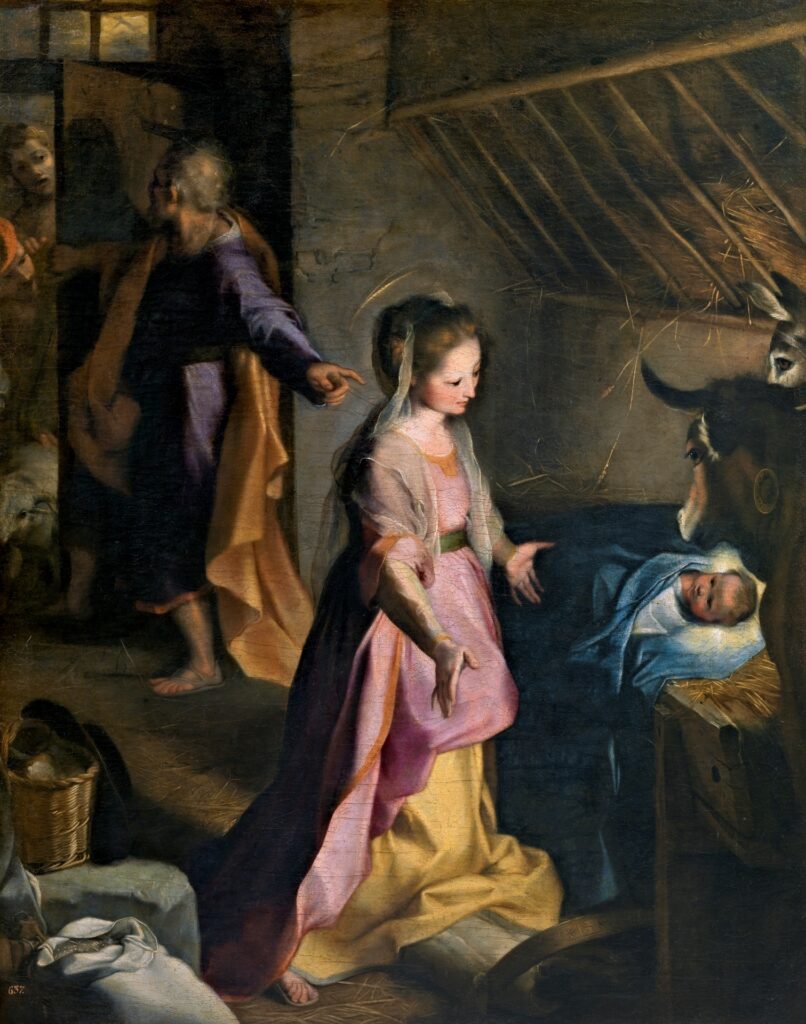
    This time of year, we begin to focus on the small baby in the manger. The spotlight shines on Joseph, Mary, and Jesus, the holy family. We see these figures placed in many nativity scenes while driving around our community. Next, we see the wise men, the shepherds, and sometimes a few farm animals or camels. Rarely do we acknowledge the others in this story; Zacharias, Elisabeth, and John. However, this isn’t so much of a surprise since John the Baptist often sought to lower himself and remain humble even in his birth narrative. 

    The message of salvation is a dominant theme in this passage. It is easy to see why people misunderstood Christ’s mission. Some might wonder why God wouldn’t just remove everything that is frightful and evil and take away sin entirely to restore righteousness, justice, and peace to the world. It’s likely that the people during Christ’s time also thought like this. They might have envisioned getting ready to take up arms, to be delivered from their enemies of oppression during the Roman world the way God led their ancestors into battle; they were ready to fight. With this mindset, it’s surely that many were also disappointed when they were told thirty years later to love their enemies instead. 

    We are reminded of the words of Isaiah 9:6 (KJV), “for unto us a child is born, unto us a son is given: and the government shall be upon his shoulder: and his name shall be called Wonderful, Counsellor, The mighty God, The everlasting Father, The Prince of Peace.

    We see this child as the Prince of Peace. But then we become confused when we hear Jesus saying:

    Think not that I am come to send peace on earth: 
    I came not to send peace, but a sword.
    Matt 10:34 (KJV)

    What does Jesus mean here? Does He bring peace or not? We begin to theologize that He must have some kind of Peace that we don’t know about because in John 14:27 (KJV), he says, “Peace I leave with you, my peace I give unto you: not as the world giveth, give I unto you. Let not your heart be troubled, neither let it be afraid.

    However, today, with tragedy reported hourly, we wonder, “Where is there peace?”

    Turning back to verse 76-79: 

    76 And thou, child, shalt be called the prophet of the Highest: for thou shalt go before the face of the Lord to prepare his ways;
    77 To give knowledge of salvation unto his people by the remission of their sins,
    78 Through the tender mercy of our God; whereby the dayspring from on high hath visited us,
    79 To give light to them that sit in darkness and in the shadow of death, to guide our feet into the way of peace.

    The child was going to be called “the prophet of the Highest…” He was going to: 

    1. He was going to prepare the way of the Lord.
    2. He was going to give knowledge of salvation to the people.
    3. He was going to demonstrate the tender mercy of God.
    4. He was going to give light to the ones who were in darkness…

    He was going “to guide our feet into the way of peace.”

    When is there peace?

    The Bible always brings up a point “if there’s a will, there is a way.” From the book of Judges: And the priest said unto them, Go in peace: before the LORD is your way wherein ye go. Judges 18:6 (KJV).

    From Proverbs: There is a way which seemeth right unto a man, but the end thereof are the ways of death. Prov 14:12 (KJV)

    The way of life is above to the wise, that he may depart from hell beneath. Prov 15:24 (KJV)

    From the gospel of Matthew: Enter ye in at the strait gate: for wide is the gate, and broad is the way, that leadeth to destruction, and many there be which go in thereat: Because strait is the gate, and narrow is the way, which leadeth unto life, and few there be that find it. Matt 7:13-14 (KJV)

    From the gospel of John: Jesus saith unto him, I am the way, the truth, and the life: no man cometh unto the Father, but by me. John 14:6 (KJV)

    Today’s gospel states that there is a “way of peace.”

    I have to conclude that this does not mean that there will be peace on earth. Not as long as the forces of darkness remain will there be peace on earth.

    But the way of peace says something much different. It means that there is a lifestyle of peace. There is an attitude of peace. There is a possibility for someone to have peace in the midst of suffering and turmoil. There is a rest in peace that may mean something far more literal and spiritual than what is printed on tombstones. There is a peace that passes all understanding. There is a peace that comes to those who seek God. And only His peace will sustain those who pray to live in peace in a troubled world.

    When is there peace? 

    There is always a great possibility for peace. Truly, we must recognize Christ as the Prince of Peace. When His peace comes to satisfy, His peace is everlasting. I HOPE TODAY YOU RECEIVE PEACE. 

    Resources: 

    Bibleinterpretation.org. “Luke 01:67-80 The Canticle of Zechariah”  

  • Hope in a Hopeless World: Discovering Christ in the First Week of Advent

    Today, we begin the season of Advent. With this beginning, we are reminded that this season is a time of hope. Yet with this season of hope, we also find ourselves thinking about those who have none.

    To start today’s message, I’d like to share a passage from the Apocrypha—The Wisdom of Solomon. This book, also known as The Book of Wisdom, is not part of the Protestant Old Testament but is included in the Deuterocanonical books recognized by the Catholic and Eastern Orthodox traditions.

    Before Jesus’ time, Jewish people used two main versions of Scripture: the Hebrew Bible, used in Israel, and the Greek Septuagint, used by Jews living in Greek-speaking regions. The Wisdom of Solomon was written in Greek about a century before Christ and was included in the Septuagint, but not in the Hebrew Bible.

    Early Christians often read from the Septuagint, so The Wisdom of Solomon was familiar and respected in the early church. After the Temple was destroyed in 70 CE, Jewish leaders recognized only the Hebrew Scriptures as their official Bible, which did not include this book. During the Protestant Reformation in the 1500s, church leaders such as Martin Luther chose to follow the Hebrew version of the Old Testament. They saw The Wisdom of Solomon as valuable reading but not inspired Scripture. The Catholic Church, however, officially retained it in 1546 at the Council of Trent.

    Even though this text isn’t part of the Protestant Bible, it still carries a valuable message. That’s why I’m including it in today’s reflection.


    Wisdom of Solomon 2:1–5 (NRSV)

    1 For they reasoned unsoundly, saying to themselves,
    “Short and sorrowful is our life,
    and there is no remedy when a life comes to its end,
    and no one has been known to return from Hades.

    2 For we were born by mere chance,
    and hereafter we shall be as though we had never been,
    for the breath in our nostrils is smoke,
    and reason is a spark kindled by the beating of our hearts;

    3 When it is extinguished, the body will turn to ashes,
    and the spirit will dissolve like empty air.

    4 Our name will be forgotten in time,
    and no one will remember our works;
    our life will pass away like the traces of a cloud
    and be scattered like mist
    that is chased by the rays of the sun
    and overcome by its heat.

    5 For our allotted time is the passing of a shadow,
    and there is no return from our death,
    because it is sealed up and no one turns back.”


    Understanding the Passage

    At the start of chapter 2, the author (King Solomon) describes a group of people who “reasoned unsoundly,” meaning they think and live without God. These are not specific individuals but rather a mindset: people who see life only through human reason and earthly experience.

    They have no faith, no belief in God, and no hope in life after death. They live as though there is no God, no judgment, and no eternal truth. They believe death is final—“no one has been known to return from Hades.” This perspective aligns with an ancient form of atheism or materialism—the idea that humans are merely biological matter, not created by God: “We were born by mere chance.”

    From such a mindset flows hopelessness: “Our name will be forgotten.” They deny divine justice and eternal life, saying, “There is no return from our death.”

    Sound familiar?

    Sadly, many of us know people like this—people who see life as limited to what happens on this earth. How do we bring them to Christ? How do we offer hope to someone who has none?

    The truth is, we never fully know another person’s spiritual journey. I’ve heard people say, “So-and-so was a lost cause—died without knowing Jesus.” But the reality is, we have no idea where that person’s heart or spirit was in their final moments.

    Our purpose is not to dwell on what we don’t know, but to lift others up with hope.

    We see people walking through life without hope—especially during this time of year. We see them rushing through shopping malls, cutting ahead in line, or grumbling about prices. They may complain that they’re “shopping to death,” frustrated about buying gifts for people they barely know.

    The commercial side of this season easily distracts us from its true meaning. Though Advent is a season filled with hope, few truly find it.


    The Source of Hope: Romans 15:7–13 (NKJV)

    7 Therefore receive one another, just as Christ also received us, to the glory of God.
    8 Now I say that Jesus Christ has become a servant to the circumcision for the truth of God, to confirm the promises made to the fathers,
    9 and that the Gentiles might glorify God for His mercy, as it is written:
    “For this reason I will confess to You among the Gentiles,
    And sing to Your name.”
    10 And again he says:
    “Rejoice, O Gentiles, with His people!”
    11 And again:
    “Praise the LORD, all you Gentiles! Laud Him, all you peoples!”
    12 And again, Isaiah says:
    “There shall be a root of Jesse;
    And He who shall rise to reign over the Gentiles,
    In Him the Gentiles shall hope.”
    13 Now may the God of hope fill you with all joy and peace in believing, that you may abound in hope by the power of the Holy Spirit.

    In this text, Paul reminds us of Isaiah’s prophecy: “There shall be a root of Jesse; and He who shall rise to reign over the Gentiles, in Him the Gentiles shall hope.”

    Jesus came for both Jews and Gentiles. The “root of Jesse” refers to Jesse, the father of King David. Jesus comes from this family line, fulfilling God’s promise that the Messiah would come from the house of David (2 Samuel 7:12–16). The term “root” suggests that Jesus is not a branch but the very source of David’s line.

    “In Him the Gentiles will find hope” shows that Jesus brings hope and salvation to everyone. God’s promise is inclusive—open to all who believe, not just to those with Jewish heritage.

    Romans 15:12 confirms that Jesus is the promised Messiah from Jesse’s line. His kingdom is for all nations. Everyone—Jew or Gentile—can find hope, salvation, and belonging in Him.


    The Creed and the Christmas Story

    As we enter this season, we celebrate the incarnation of Christ—God made flesh. We witness the fulfillment of ancient prophecies and continue to proclaim our faith through the Apostles’ Creed:

    I believe in God, the Father almighty,
    Creator of heaven and earth.
    I believe in Jesus Christ, his only Son, our Lord.
    He was conceived by the power of the Holy Spirit 
    and born of the Virgin Mary…

    This part of the creed is especially meaningful today. Hope is found in a belief system rooted in the truth of Christ, born of the Virgin Mary. The Christmas story must be believed in its entirety. If we abandon any part of it, we weaken the very message that brings us hope.

    If Christ were not born of the Virgin Mary, we would have to question whether He came into the world at all. And if Jesus did not come into the world, how could anyone claim Him as the One who brings hope?


    Where Is the Hope?

    Hope is found in Jesus Christ.
    We read about it. We sing about it.

    Edward Mote expressed it beautifully in his hymn:

    My hope is built on nothing less
    than Jesus’ blood and righteousness.
    I dare not trust the sweetest frame,
    but wholly lean on Jesus’ name.

    On Christ, the solid rock, I stand;
    all other ground is sinking sand.

    As Paul wrote to the Romans:

    “Now may the God of hope fill you with all joy and peace in believing, that you may abound in hope by the power of the Holy Spirit.” (Romans 15:13)

    Paul knew that there is peace in believing. God is the source of all hope, and joy and peace come through the power of the Holy Spirit.

    May we find hope in Jesus Christ today.
    May that hope strengthen us through the holiday season and carry us into a new year.


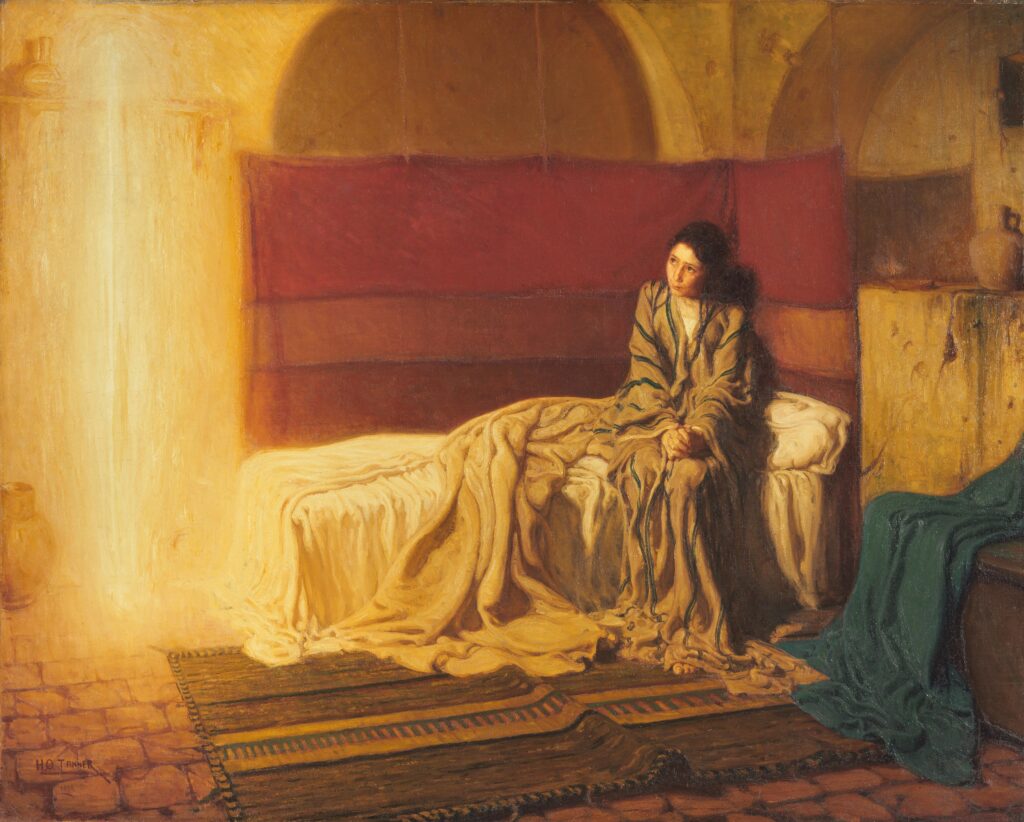
    About The Art: The Annunciation (1898) by Henry Ossawa Tanner

    The Annunciation (1898) is one of Henry Ossawa Tanner’s most celebrated works, offering a fresh and intimate interpretation of the moment the angel announces to Mary that she will bear Christ. Instead of portraying the angel in human form, Tanner uses a glowing column of light, emphasizing the holiness of the moment while keeping the scene grounded and realistic. His subdued colors, gentle lighting, and focus on Mary’s expression highlight the humility, awe, and humanity of this encounter.

    Tanner—born in 1859 and the first African American painter to gain international recognition—often drew on his Christian faith in his art. His move to Paris allowed him to escape racial prejudice in the United States and refine his style within the European art tradition. The Annunciation reflects both his spiritual depth and his artistic mastery, capturing a sacred moment with emotional honesty and reverent beauty.