• “He is Greatly Exalted:” Celebrating Christ’s Resurrection this Easter in Psalm 47

    Before we jump into the celebration this Easter Sunday, I want to rewind a moment back to when Jesus was on the cross, Luke 23:39-43 (NCV): 

    39 One of the criminals on a cross began to shout insults at Jesus: “Aren’t you the Christ? Then save yourself and us.”
    40 But the other criminal stopped him and said, “You should fear God! You are getting the same punishment he is. 41 We are punished justly, getting what we deserve for what we did. But this man has done nothing wrong.” 42 Then he said, “Jesus, remember me when you come into your kingdom.”
    43 Jesus said to him, “I tell you the truth, today you will be with me in paradise.” 

    Luke tells us that “the other criminal” on the cross… 

    • Acknowledged his wrongdoings. 
    • He accepted his justified punishment.
    • He believed in Jesus and asked Jesus to remember him.
    • He had faith that Jesus was the Messiah of God.
    • He believed there was a “kingdom” of God.
    • He believed there was a life after death!  

    Those who stood under the cross and witnessed the thief’s ramblings must have thought these men were out of their minds. But this sinner had faith. He called upon the name of the Lord and was saved.

    With this in mind, let us look at Psalm 47.1-2: 

    1 Oh, clap your hands, all you peoples!
    Shout to God with the voice of triumph!
    2 For the Lord Most High is awesome; 
    He is great a King over all the earth

    On Resurrection Sunday, which we also refer to as Easter, we gather to celebrate the resurrection power of our risen Lord. Christ is risen! Christ is risen indeed!  Isn’t that what it is all about?

    This is often a day we welcome the CEO Christians (Christian-Easter-Only Christians) into our church. Which leaves us asking, why this Sunday? Why today? Why did you come to church this morning?  For some people:

    • I wanted to see the pretty flowers.
    • I wanted to show off my new clothes.
    • I am here because that is what my family wanted to do today.
    • I am here because I always attend church on Christmas and Easter.
    • I am here because of Mama!
    • I am here because I want to get my religion out of the way for a while, sort of pay my yearly dues.
    • I am here out of obligation.  Where does this obligation come from, I do not know?

    To all, you are welcome here in church today. You are welcome every Sunday. To our CEO Christian friends, we hope after today you will return next week, and the week after. Because you belong here. However, all of these reasons, are WRONG reasons for coming to church on Easter Sunday. It is about God! Not you or I! Do any of these reasons apply to your life this morning?  If not, maybe you are here for all the right reasons.

    Art: Simon Dewey, “He Lives”

    There is an old joke we hear often – It was Easter Sunday in Sunday School.  Mrs. Ross was trying to teach her students about the meaning of Easter.  

    What does Easter mean? She asked.

    Little Suzie put up her hand and Mrs. Ross acknowledged, Okay, Suzie go ahead…

    It is when we get to hunt Easter Eggs! Suzie said.

    Mrs. Ross answered, Yes, that is partially true.

    Turning to little Bobby, she asked if he knew.

    Bobby said,  Is that when we get to go to Jesus’ funeral?

    Mrs. Ross said, Not quite.

    She turned to little Billy, Billy, do you know what the meaning of Easter is?

    Billy paused for a moment:  It is the day Jesus rose from the dead.

    Mrs. Ross was excited, “Yes, go on!”

    Bobby said, And Jesus comes out of the tomb…  

    Yes, go on! 

    And when he sees his shadow, we will have six more weeks of Easter!

    This is one of the problems we have today is the problem of Biblical illiteracy.  We don’t know the Bible. Psalm 47:1-2, again, reads: 

    1 Oh, clap your hands, all you peoples! 
     Shout to God with the voice of triumph! 
     2 For the Lord Most High is awesome; 
    He is a great a King over all the earth. 

    We celebrate today not only the event where Jesus Christ rose triumphantly from the dead.  But because “He is the great King over all the earth!”  He is the creator and ruler of the universe!  Jesus Christ is Lord!

    In the Psalmic tradition, we are to “clap our hands” and “Shout to God.”  This might look different from church to church. Some might literally be clapping their hands and shouting, while others might have a true and meaningful way of worship through songs of praise. Yet, some Christians get caught up in clapping and shouting that they forget (or do not know) the deep spiritual sense as to why.

    • Why am I clapping my hands?
    • Why am I shouting?
    • Why am I here?
    • And what is the meaning of life? Maybe I will go and ask Plato.

    Another great and wonderful dynamic act of worship is singing praise to God.  Singing praise to God from our hearts.  In Psalm 47.6-7:

    6 Sing praises to God, sing praises!
    Sing praises to our King, sing praises!
    7 For God is the King of all the earth;
    Sing praises with understanding.

    We sing praises to God and we know WHY we are praising Him. In Psalm 47.5:

    5 God has gone up with a shout,
    The Lord with the sound of a trumpet.

    This verse speaks of God going up, which we also refer to as ascension. The last words in Luke’s Gospel read (Luke 24:49-55 (NKJV)):

    49 Behold, I send the Promise of My Father upon you; but tarry in the city 4of Jerusalem until you are endued with power from on high.” 
    50 And He led them out as far as Bethany, and He lifted up His hands and blessed them. 51 Now it came to pass, while He blessed them, that He was parted from them and carried up into heaven. 52 And they worshiped Him, and returned to Jerusalem with great joy, 53 and were continually in the temple 5praising and blessing God. 

    The first six sentences of the Apostles Creed are:

    1. I believe in God the Father, Almighty, Maker of heaven and earth: 
    2. And in Jesus Christ, his only begotten Son, our Lord: 
    3. Who was conceived by the Holy Ghost, born of the Virgin Mary: 
    4. Suffered under Pontius Pilate; was crucified, dead and buried: He descended into hell: 
    5. The third day he rose again from the dead: 
    6. He ascended into heaven, and sits at the right hand of God the Father Almighty: 

    The Apostles Creed represents basic Christian doctrine.  

    1. We believe in God.
    2. We believe in the Son of God—Jesus Christ.
    3. We believe in the virgin birth of Jesus as conceived by the Holy Spirit.
    4. We believe that he stood condemned by Pontius Pilate, was crucified, died, was buried, and went to visit hell.
    5. On the third day, Jesus rose from the dead.
    6. He ascended/went up into heaven, and He sits on the throne at the right hand of God.

    If someone were to ask you what is so great about Christians going to church on Easter Sunday. Would you tell them it is about celebrating our risen Lord? Would you tell them because Jesus is worthy of our praise and He is greatly exalted? 

    Tell them it is because “HE IS GREATLY EXALTED” (Psalm 47:9)!

    Sermon Title: Clap Your Hands All You Peoples | First Christian Church (DOC) Winfield, Kansas April 8, 2012
  • The Meaning of Peter’s Denial on Good Friday – A Closer Look at Betrayal and Forgiveness

    For this Good Friday, let’s turn our focus to Peter—his denial of Jesus, but also key moments from his life that shaped his faith and discipleship. His story is one of deep failure, but also deep grace. And it calls us to look inward at our own journey with Christ.

    We first meet Peter in Luke 5, where he is out fishing—unsuccessfully. After a long night of catching nothing, Jesus steps into Peter’s boat and tells him where to cast his nets. Peter responds, “Master, we have toiled all night and caught nothing.”

    How often does God lead us to do something, and our first response is an excuse? If we are even remotely conscious of God’s presence, we must understand that God knows the truth of our hearts. We can’t lie to Him. So, who are we trying to fool with our excuses?

    But Peter obeyed. “Nevertheless, at Your word I will let down the net.” And what happened next was miraculous. The net was so full of fish it began to break. In that moment, Peter realized he was not standing in the presence of an ordinary man. He fell at Jesus’ knees and said, “Depart from me, for I am a sinful man, O Lord!” He might as well have added, “I’m not worthy of even being near You.” Yet Jesus did not leave. He stayed. He called Peter to follow Him.

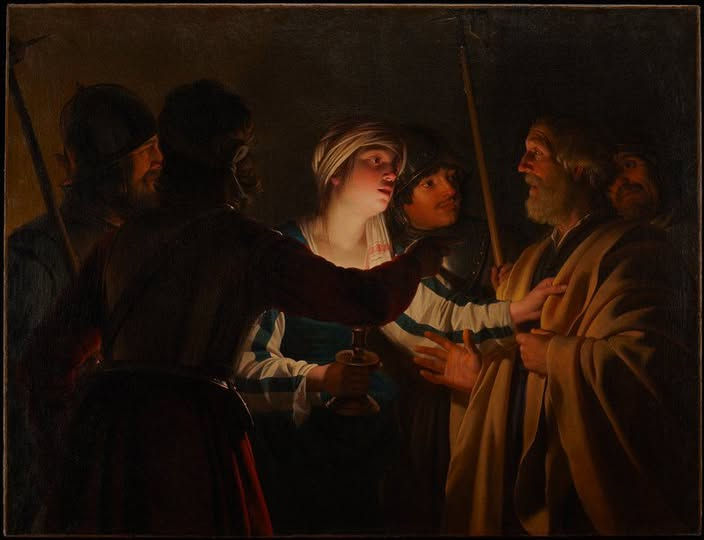
    Gerrit van Honthorst The Denial of St Peter c.1623

    Later, in Matthew 16, we see another pivotal moment. Jesus asks His disciples, “Who do people say that I am?” They offer various answers—“Some say John the Baptist, others Elijah, and still others Jeremiah or one of the prophets.” But those were just the rumors.

    Then Jesus asks the real question: “But who do you say I am?”

    That’s the question we all must answer. Who do you say Jesus is? Was He just a moral teacher? A historical figure? A religious symbol? Or is He truly the Son of God, the Messiah, the Lord of your life?

    Peter gives the right answer: “You are the Messiah, the Son of the living God.” But he didn’t arrive at that answer on his own. Jesus tells him, “Flesh and blood has not revealed this to you, but My Father in heaven.” This was spiritual revelation—truth planted in Peter’s heart by the Holy Spirit.

    Jesus then says:

    Matthew 16:18–19 (NKJV) 18 “And I also say to you that you are Peter, and on this rock I will build My church, and the gates of Hades shall not prevail against it. 19 And I will give you the keys of the kingdom of heaven, and whatever you bind on earth will be bound in heaven, and whatever you loose on earth will be loosed in heaven.”

    Fast forward to Luke 22—the Last Supper. Jesus gathers with His disciples and says:

    Luke 22:14–16 (NKJV) 14 “When the hour had come, He sat down, and the twelve apostles with Him. 15 Then He said to them, ‘With fervent desire I have desired to eat this Passover with you before I suffer; 16 for I say to you, I will no longer eat of it until it is fulfilled in the kingdom of God.’”

    Did Peter have any clue this would be their final meal with Jesus? Probably not. It likely felt like any other gathering—good food, strong fellowship. Then things took a turn. Jesus begins speaking about betrayal. The disciples argue about who it could be, then shift into a dispute about who among them is the greatest.

    And in the midst of this, Jesus turns to Peter and says, “Simon, Simon, Satan has asked to sift you like wheat. But I have prayed for you, that your faith may not fail.”

    Peter, with passion, declares, “Lord, I am ready to go with You, both to prison and to death!” But Jesus knows better. He replies, “Peter, before the rooster crows, you will deny three times that you know Me.”

    Later that night, Jesus is arrested. A mob, led by Judas, comes to seize Him. Chaos. Fear. Confusion.

    Peter follows, but from a distance. At the high priest’s courtyard, as Jesus is put on trial, Peter tries to stay unnoticed. He only wants to warm himself by the fire. But then, a servant girl recognizes him: “This man was with Him.”

    Peter says, “Woman, I do not know Him.”

    Later, someone else insists, “You’re one of them.”

    “Man, I am not!”

    About an hour passes, and another person says, “Surely this man was with Jesus—his accent gives him away.” According to Matthew’s Gospel, Peter begins cursing and swearing. “Man, I do not know what you’re talking about!”

    And then the rooster crowed.

    Peter remembered what Jesus had said. Overwhelmed with shame, he went outside and wept bitterly.

    Was Peter there at the crucifixion? The Gospels don’t clearly say. Maybe he was. Maybe he watched from a distance. But we do know this: he was heartbroken. The one he loved was dying, and he had denied even knowing Him.

    Could Peter ever forget the look Jesus gave him in that courtyard? The eyes of the one he had denied? The memory must have haunted him. But don’t forget Jesus’ words: “I have prayed for you, that your faith may not fail.” When the Son of God prays for you, your story doesn’t end in failure. Not because of your strength but because of His.

    Each person present that night had a part in the story. Some watched silently. Some mocked. Some betrayed. Some scattered. Some, like John, stayed by the cross. Jesus’ mother, Mary, was there too. Perhaps Mary, Martha, and Lazarus were among the crowd. Crucifixion was a public display of shame—a message to all: this is what happens to rebels. The more people watching, the better for Rome.

    And yet, even amid that shame and suffering, God’s purpose was unfolding.

    Judas, filled with remorse, took his own life. Peter, filled with grief, would later find forgiveness. Jesus was crucified, died, and was buried.

    This is what Good Friday is about—remembering the cross. This is the one day we pause, and we do not rush ahead to Easter Sunday. We leave Jesus on the cross, not because He’s still there, but to remember the cost.

    Many today wear crosses as jewelry but do not understand what it truly represents. The cross is not just a symbol of suffering—it is a call to discipleship. As William Penn wrote, “No Cross, No Crown.” Without enduring the cross, there is no hope for the crown.

    Luke 9:23–26 (NKJV) 23 “If anyone desires to come after Me, let him deny himself, and take up his cross daily, and follow Me. 24 For whoever desires to save his life will lose it, but whoever loses his life for My sake will save it. 25 For what profit is it to a man if he gains the whole world, and is himself destroyed or lost? 26 For whoever is ashamed of Me and My words, of him the Son of Man will be ashamed when He comes in His own glory…”

    There’s so much in that passage. But focus on this: “Take up your cross daily.” That means the cross is not distant, not abstract—it is personal. We each carry one. And in doing so, we walk the path Christ walked.

    Today, we remember His cross.

    Sermon: I Don’t’ Even Know the Man | March 29, 2024 Shubert Christian Church, Shubert, Nebraska / April 6, 2012 First Christian Church (DOC) Winfield, KS

  • If You Have Love: Exploring Christ’s Love Through Maundy Thursday (John 13)

    Today is Maundy Thursday, also known as Holy Thursday. The name is thought to be a Middle English derivation taken from a Latin anthem sung in Roman Catholic churches on that day: “Mandatum novum do vobis” (“a new commandment I give to you;” John 13:34). For today’s notes, we are reviewing John 13:20-36 (ESV):

    20 Truly, truly, I say to you, whoever receives the one I send receives me, and whoever receives me receives the one who sent me.” 

    21 After saying these things, Jesus was troubled in his spirit, and testified, “Truly, truly, I say to you, one of you will betray me.” 22 The disciples looked at one another, uncertain of whom he spoke. 23 One of his disciples, whom Jesus loved, was reclining at table at Jesus’ side, 24 so Simon Peter motioned to him to ask Jesus of whom he was speaking. 25 So that disciple, leaning back against Jesus, said to him, “Lord, who is it?” 26 Jesus answered, “It is he to whom I will give this morsel of bread when I have dipped it.” So when he had dipped the morsel, he gave it to Judas, the son of Simon Iscariot. 27 Then after he had taken the morsel, Satan entered into him. Jesus said to him, “What you are going to do, do quickly.” 28 Now no one at the table knew why he said this to him. 29 Some thought that, because Judas had the moneybag, Jesus was telling him, “Buy what we need for the feast,” or that he should give something to the poor. 30 So, after receiving the morsel of bread, he immediately went out. And it was night. 

    31 When he had gone out, Jesus said, “Now is the Son of Man glorified, and God is glorified in him. 32 If God is glorified in him, God will also glorify him in himself, and glorify him at once. 33 Little children, yet a little while I am with you. You will seek me, and just as I said to the Jews, so now I also say to you, ‘Where I am going you cannot come.’ 34 A new commandment I give to you, that you love one another: just as I have loved you, you also are to love one another. 35 By this all people will know that you are my disciples, if you have love for one another.” 

    I like the idea of having a meal, or as referenced in this scripture, I like the idea of a feast. Following the traditions of Jesus, when he fed the thousands, everyone left with a full stomach. [Mark 6:42; Mark 8:8] Much in the way that we often do when we celebrate Thanksgiving, Christmas, and many other holidays. We leave stuffed! We leave full! Therefore, when Jesus sat down to eat his last meal with his disciples, I am sure for the most part they felt like it was a feast, or a feast full of celebration. Little did they know that afterward, the events that took place were much less to celebrate. 

    My wife, Pamela, gave me an idea the other day about Judas Iscariot and even Peter, who would later deny Jesus. Both of these men sat down and ate this meal. Peter, thinking that he would even die for Jesus would later discover his human weakness and deny Jesus. Judas, however, was different. His betrayal was premeditated. When he sat down to partake of this meal, he knew quite well what he was going to do. 

    Therefore, we know what Jesus said: “What you are going to do, do quickly.” 

    What we do not know is what Judas said. Did he say, “I am sorry, Jesus, but I am not feeling very well this evening, and so I will not be joining you for dinner?” One would think that if they were going to betray the son of God and Savior of the world, they would not be able to sit down and eat a meal that he provided. No. We know that Judas was there. And Judas ate, and likely he ate until he was full and satisfied.

    Of course, we cannot be too critical of these men because when it came time for Jesus to be arrested and put on trial, all of his followers fled. But this was a feast and a last meal, and Jesus left them with some final instructions (John 13:34-35, NKJV):

    34 A new commandment I give to you, that you love one another; as I have loved you, that you also love one another. 35 By this all will know that you are My disciples, if you have love for one another.”

    During this Holy Week, we are given many opportunities to focus on these events. From Maundy Thursday to the Last Supper, the washing of feet, the prayers in the garden, and the arrest and trial of Jesus. Each one of these events could provide a whole worship service experience. But of all of these, the most important element from all these events is love. 

     If you have love for one another.

    That is what Christ wanted to emphasize. That is what is needed inside the church today. Inside the fellowship of believers must be love. As we reflect on this passage from John 13, we are reminded of both the deep love of Jesus and the painful reality of His coming betrayal. This moment at the table is intimate, emotional, and powerful. Jesus not only reveals His knowledge of the events to come but also demonstrates His heart of compassion and service, even toward those who would turn against Him. Maundy Thursday calls us to remember Christ’s commandment to love one another as He has loved us — sacrificially, humbly, and completely. It is a time to examine our own hearts, to receive His love, and to extend that love to others.

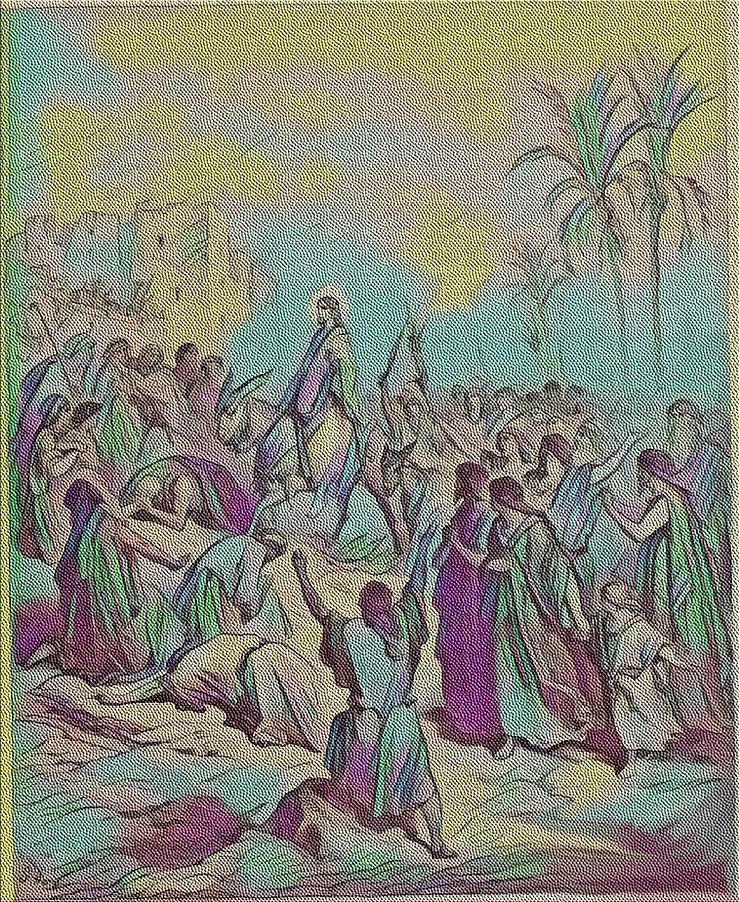
  • The Significance of “Hosanna” and The Triumphal Entry in Celebrating Palm Sunday

    As the Season of Lent comes to a close, we turn to Mark 11:1-11 (NKJV): 

    1 Now when they drew near Jerusalem, to Bethphage and Bethany, at the Mount of Olives, He sent two of His disciples; 2 and He said to them, “Go into the village opposite you; and as soon as you have entered it you will find a colt tied, on which no one has sat. Loose it and bring it. 3 “And if anyone says to you, ‘Why are you doing this?’ say, ‘The Lord has need of it,’ and immediately he will send it here.” 4 So they went their way, and found the colt tied by the door outside on the street, and they loosed it. 5 But some of those who stood there said to them, “What are you doing, loosing the colt?” 6 And they spoke to them just as Jesus had commanded. So they let them go. 7 Then they brought the colt to Jesus and threw their clothes on it, and He sat on it. 8 And many spread their clothes on the road, and others cut down leafy branches from the trees and spread them on the road. 9 Then those who went before and those who followed cried out, saying: 
    “Hosanna! 
    ‘Blessed is He who comes in the name of the Lord!’
    10 Blessed is the kingdom of our father David 
    That comes in the name of the Lord! 
    Hosanna in the highest!”
    11 And Jesus went into Jerusalem and into the temple. So when He had looked around at all things, as the hour was already late, He went out to Bethany with the twelve.

    Holy Week officially begins. The quiet time that we have spent in spiritual reflection is now interrupted with noise coming from the crowds. We hear voices crying, “Hosanna!  Hosanna!  Blessed is the One who comes in the name of the Lord.  Hosanna!  Hosanna!  Blessed is the coming kingdom of our father David!  Hosanna in the highest!”

    Depending on what particular study Bible you have, this event is more popularly labeled as “The Triumphal Entry.” We celebrate it as Palm Sunday, even though according to Mark’s gospel, there is no mention of palm branches. The description says “leafy branches.” The type of branches seems irrelevant. The focus here is on the act of worship.

    So, why is this entry considered triumphal? 

    Some people might wonder why this is called The Triumphal Entry. Considering the crucifixion of Jesus that takes place later, it is more of a triumph turned tragedy. The people cry out “Hosanna,” which means, “Save us,” or “Save now.” The act of saving would most certainly be expected, that is, if Jesus is the Messiah, the Christ of God.  And we believe that He is.

    But still, one has to have some appreciation for the dramatization done by Mark’s gospel.  Mark is a short gospel and does not offer a lengthy dissertation. The story shifts in Mark 10, with Jesus healing Blind Bartimaeus as he is approaching Jerusalem. The people who believe in Jesus are there to greet Him, offering shouts of praise, and some probably expecting Him to claim His rule as the Messiah.

    We know the gospel’s story.  Jesus does not claim any throne.  He gets arrested.  Jesus does not gain any high recognition or respect.  He gets mocked and ridiculed.  As I just referred to the dramatization of Mark’s story, the Hosanna cries quickly turn to cries of mourning.  Faith most surely turns to doubt, as the One who appears to be the Savior is unable to save Himself.

    Mark’s gospel gives a good account of the mockery that is said.   Mark 15.27-32 reads:

     27 Two criminals were crucified with him, their crosses on either side of his. 29 And the people passing by shouted abuse, shaking their heads in mockery. “Ha! Look at you now!” they yelled at him. “You can destroy the Temple and rebuild it in three days, can you? 30 Well then, save yourself and come down from the cross!”
    31 The leading priests and teachers of religious law also mocked Jesus. “He saved others,” they scoffed, “but he can’t save himself! 32 Let this Messiah, this king of Israel, come down from the cross so we can see it and believe him!” Even the two criminals who were being crucified with Jesus ridiculed him.

    When one examines the whole story that occurs from triumphal entry to crucifixion, it may be difficult for some people to see the triumph of the occasion.  On the other hand, it seems more of a failure on the people’s part to understand the true person Jesus was and what His mission was—what He came to do. 

    They were not seeing Jesus through the window of Isaiah 53.3-12:

    He was despised and rejected—a man of sorrows, acquainted with bitterest grief. We turned our backs on him and looked the other way when he went by. He was despised, and we did not care. 
    Yet it was our weaknesses he carried; it was our sorrows that weighed him down. And we thought his troubles were a punishment from God for his own sins! 5 But he was wounded and crushed for our sins. He was beaten that we might have peace. He was whipped, and we were healed! 6 All of us have strayed away like sheep. We have left God’s paths to follow our own. Yet the Lord laid on him the guilt and sins of us all.
    He was oppressed and treated harshly, yet he never said a word. He was led as a lamb to the slaughter. And as a sheep is silent before the shearers, he did not open his mouth. 8 From prison and trial they led him away to his death. But who among the people realized that he was dying for their sins—that he was suffering their punishment? He had done no wrong, and he never deceived anyone. But he was buried like a criminal; he was put in a rich man’s grave.
    10 But it was the Lord’s good plan to crush him and fill him with grief. Yet when his life is made an offering for sin, he will have a multitude of children, many heirs. He will enjoy a long life, and the Lord’s plan will prosper in his hands. 11 When he sees all that is accomplished by his anguish, he will be satisfied. And because of what he has experienced, my righteous servant will make it possible for many to be counted righteous, for he will bear all their sins. 12 I will give him the honors of one who is mighty and great, because he exposed himself to death. He was counted among those who were sinners. He bore the sins of many and interceded for sinners.

    We turn back to the question, why is this considered Triumphal? On the surface, it appears to be one of the great tragedies of all time.  If there had been the technology for newspapers, the headlines might have read: 

    RELIGIOUS RADICAL, PUBLIC MENACE, 

    EXECUTED BY THE ROMAN GOVERNMENT.

    Still, as one gains an understanding of what, or rather whom, Jesus came to save–then his entry was triumphal. We understand better that Jesus did not come into the world to become a political leader to liberate his people. Jesus came to seek and to save the lost. [Luke 19.10] Jesus came to save sinners. Jesus came to save all of the human race, past, present, and future, from death and destruction. Furthermore, we understand being saved as being allowed to live life with Jesus after we die.

    What has occurred then through the triumphal entry is the announcement of the greatest form of salvation. Had Jesus been a political ruler like King David, the people might have been content for a time under his rule. But what happens when the king dies? Another king comes to rule. In the history of the Old Testament, there were good kings and even more wicked kings. The people during Jesus’ time were living under the rule of wicked kings. Why would the world need another earthly king?

    But now the problem is solved. It no longer matters who the king reigning on the earth is.  There is now an appointed king who will rule for all of eternity.   This King who comes—comes in triumph—triumphal entry. 

    What does this mean for us today? Today, we have a wonderful privilege, to offer worship to the One who has saved us.  Today, we have the option to cry out “Hosanna,” and from the very moment we utter our cry, the Savior hears us. Did you ever think how easy it is to be saved? I am not talking about how easy it is to live the Christian life because living the Christian life is not easy.  But being saved is easy. Being saved is as easy as saying to Jesus Christ, “Hosanna—save me, Lord!”   

    Of course, what is equally important is that your cry comes from the depths of your heart.   It is like falling into a rapidly moving stream and being carried down the river. You realize that unless something miraculously happens, you are sure to drown. And then, as you grab hold of your senses, you know there is only one thing to do. You cry out as loud as you can, “Help…someone, save me!” Usually, those people standing safely on the side of the bank are not arguing amongst themselves, “Well, what do you think? Is that an earnest cry for help?” Maybe I am expecting too much here with my illustration.  

    In some places in this country, the reaction might be: 

    “I just don’t want to get involved!”  

    “If I go rescue that person crying for help—my luck they would hit their head on a rock in the process and then sue me for all I am worth.” 

    Then there are those people who say,

    “What? I can’t hear you! Do you need help?”

    “Too late; I guess they did not need my help.”  

    Still believing there is some goodness left in humanity, most will attempt to rescue a person who is drowning. With the same kind of reaction, Jesus is quick to rescue us.

    Romans 10.13:

    13 For “whoever calls on the name of the Lord shall be saved.”

    Considering the invitation, is there anyone who is drowning? Is there anyone who needs saving? It is our purpose to continue the ministry of Jesus Christ, to seek and to save the lost. We give an invitation to those who are seeking salvation, as well as those who are seeking a family of faith.

    Sermon: “Hosanna” | April 16, 2000, at FCC Paradise, California and April 5, 2009, FCC Winfield, KS