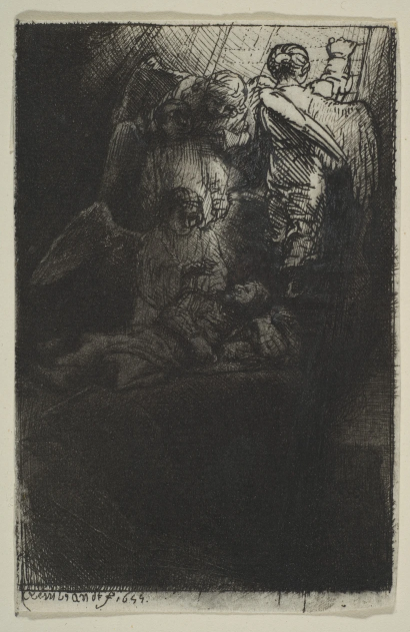
Never Work For Your Relatives: Lessons from Genesis 30-31
In the summers of 1977 and 1978, I was offered a job to work for my cousin driving a combine during wheat harvest. Running two combines it took about three-and-a-half to four weeks to harvest the wheat. The first summer, my cousin said that he would pay me $25 a day to drive a combine. At 16 years old, I enjoyed driving the combine so I didn’t think much of it at the time. The next summer he gave me a rais; $30 a day. Again, I loved driving the combine so I didn’t complain.
However, it was an itchy, dirty job. The days were at least 12 hours with some going beyond 16 hours, harvesting from 7:30 AM to 1:00 AM the following morning. Then to drive home, shower, and sleep, and be back to the field by 6:30 AM, to refuel and service the combine. At $30 a day divided by 16 hours, I was working about $1.88 an hour. That was well below the minimum wage which was $2.30 an hour. Even working at my dad’s garage, I was making $2.00 an hour.

Did I feel that I was being ripped off? At the time, not really. I trusted my cousin was being fair with me. But, my dad said to me that he felt our cousins were taking advantage of me. Did we drive out to the field and start carrying our picket signs in protest to the unfair wage? No! We did not. But, my dad taught me a lesson about how it’s not wise to work for your relatives. A lesson that I have never forgotten.
Do I carry any ill will toward my family? No! I wouldn’t trade those memories for the world and would probably do it all again. However, the lesson still remains in my mind especially as we study Genesis 31:1-7 (NKJV):
1 Now Jacob heard the words of Laban’s sons, saying “Jacob has taken away all that was our father’s, and from what was our father’s he has acquired all this wealth.” 2 And Jacob saw the countenance of Laban, and indeed it was not favorable toward him as before. 3 Then the LORD said to Jacob, “Return to the land of your fathers and to your family, and I will be with you.”
4 So Jacob sent and called Rachel and Leah to the field, to his flock, 5 and said to them, “I see your father’s countenance, that it is not favorable toward me as before; but the God of my father has been with me. 6 And you know that with all my might I have served your father. 7 Yet your father has deceived me and changed my wages ten times, but God did not allow him to hurt me.
It seems that this was a case of love at first sight. When Jacob first met Rachel, he kissed her, and then he wept (Genesis 29:11). It didn’t matter that she was his first cousin. God didn’t address the issues of incest until much later. Jacob went to Rachel, he wanted her and was willing to work for her father in order to marry her. However, Rachel’s father, Laban, deceived Jacob and when the time came for Jacob to marry Rachel, Laban substituted his daughter Leah instead. After unknowingly having intercourse with her, Jacob discovered it was not Rachel and returned to Laban saying “why have you deceived me?”
Laban agreed to give Rachel to Jacob on the basis that he would work for him for another seven years (Genesis 29:25-27). However, as time passes and Jacob has almost finished his agreement, Laban begins to realize that Jacob is making him a lot of money so he contracts Jacob to work even longer.
The original agreement was (Genesis 30:31-33, NKJV):
31 So he [Laban] said, “what shall I give you?”
And Jacob said, “You shall not give me anything. If you will do this thing for me, I will again feed and keep your flocks: 32 Let me pass through all your flock today, removing from there all the speckled and spotted sheep, and all the brown ones among the lamps, and the spotted and speckled among the goats; and these shall be my wages. 33 So my righteousness will answer for me in time to come, when the subject of my wages comes before you: every one that is not speckled and spotted among the goats, and brown among the lamps, will be considered stolen, if it is with me.”
It is evident that God blessed Jacob. Because, over time Jacob’s flocks turned out to be strong, and well fed compared to Laban’s flocks. Therefore, Laban’s other sons became involved in sharing their complaints (Genesis 31). The sons felt that Jacob was robbing them of the inheritance they’d receive from their father. Realizing the hostility, Jacob decides to leave, especially after God told him:
3 Then the LORD said to Jacob, “Return to the land of your father and grandfather and to your relatives there, and I will be with you.” (Genesis 31:3, NLT)
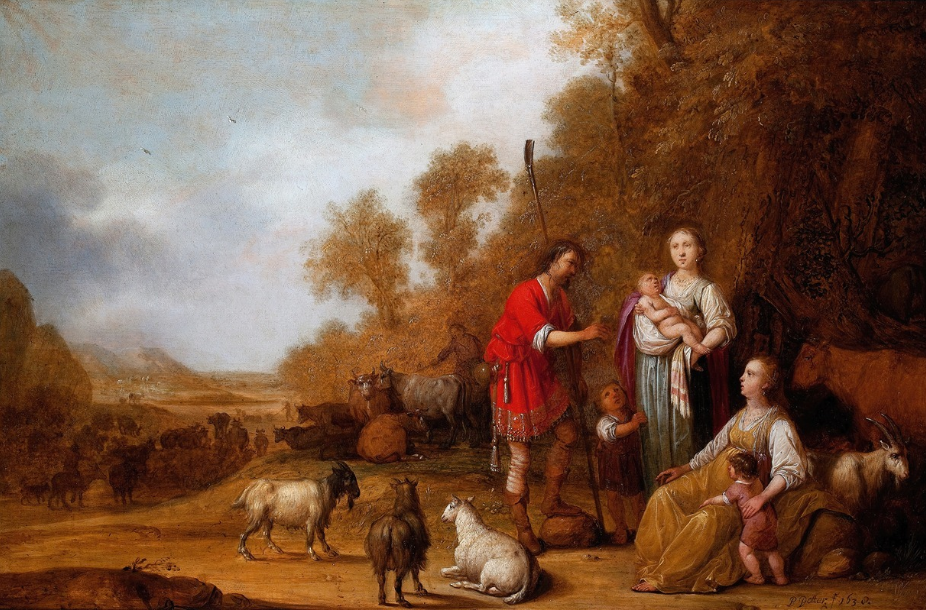
Pieter Symonsz Potter (Dutch, 1597–1652)
At this time, Jacob felt he did not owe Laban anything. In fact, his own complain was:
6 You know how hard I have worked for your father, 7 but he has cheated me, changing my wages ten times. But God has not allowed him to do me any harm. (Genesis 31:6-7, NLT)
“Cheated me,” is a strong phrase; “deceived” isn’t much better. But the point is, Jacob is telling his wife that her father took advantage of him. Whereas, depending on who you talk to, Laban or his sons, the question might be: who took advantage of who?
Then, Rachel and Leah list their own complaints (Genesis 31: 14-16, NLT):
14 Rachel and Leah responded, “That’s fine with us! We won’t inherit any of our father’s wealth anyway. 15 He has reduced our rights to those of foreign women. And after he sold us, he wasted the money you paid him for us. 16 All the wealth God has given you from our father legally belongs to us and our children. So go ahead and do whatever God has told you.”
The women have their own reasons for their hostilities. With their belief that the Bible is based on a “patriarchal paradigm,” most women were considered lesser than men, with little of their own rights. Examining ancient culture, this is quite evident and true. It is certainly not an idea that is built upon righteousness, nor does it indicate any of God’s love being lost to women.
Continuing with the story, Jacob and his family head off without telling Laban. When Laban catches up to them, he also airs his own complaint (Genesis 31:25-29, NLT):
25 Laban caught up with Jacob as he was camped in the hill country of Gilead, and he set up his camp not far from Jacob’s. 26 “What do you mean by deceiving me like this?” Laban demanded. “How dare you drag my daughters away like prisoners of war? 27 Why did you slip away secretly? Why did you deceive me? And why did you say you wanted to leave? I would have given you a farewell feast, with singing and music, accompanied by tambourines and harps. 28 Why didn’t you let me kiss my daughters and grandchildren and tell them good-bye? You have acted very foolishly! 29 I could destroy you, but the God of your father appeared to me last night and warned me, ‘Leave Jacob alone!’
Based on what we know about Laban, it is pretty unlikely he would have thrown a farewell feast for his daughters and Jacob. Especially since we know that Laban was deceptive, it’s likely that he would have come up with another scheme. Additionally, Laban’s hostility toward them, reminding Jacob, “I could destroy you!” Yet, there’s one slight problem, or rather one big problem. A big God. An Almighty God. Who warns Laban, “leave Jacob alone!” The lesson here: It’s always good to have God on your side.
What do we learn from the challenges these families faced? From the story of Jacob and Laban, we gain insight into human relationships, ethics, perseverance, and God’s providence.
We learn patience and perseverance. Jacob worked for Laban for 20 years. Seven years for Rachel, another seven for Leah, and six more years for livestock. Despite the deceit and unfair treatment, Jacob persevered. This teaches us that achieving our goals often requires enduring difficult circumstances and remaining steadfast.
We learn the consequences of deception. Both Jacob and Laban engaged in deceptive practices. Jacob deceived his father, Isaac, to receive the blessing meant for Esau, and Laban deceived Jacob by giving him Leah instead of Rachel. These actions led to complicated family dynamics and strained relationships.
We learn God’s sovereignty and faithfulness. Despite the human flaws and deceptive actions, God’s plan continued to unfold. God promised to bless Jacob and was faithful to that promise, even when Jacob faced difficulties. This teaches us that God’s plans are sovereign, and His faithfulness endures despite human failures. It reassures us that God can bring about good from our circumstances and remains in control even when things seem chaotic.
We learn how to work diligently and ethically. Jacob worked diligently for Laban, even when he was treated unfairly. This underscores the value of working hard and maintaining a strong work ethic, regardless of how others treat us. It also reminds us to trust that God sees out efforts and will reward us in His timing.
We learn how to set boundaries. Eventually, Jaco realized that he needed to separate from Laban to fulfill God’s plan for his life. He took his family and possessions and left. This teaches us the importance of setting boundaries in relationships, especially when those relationships are harmful or exploitative. It is crucial to recognize when it is time to move on for our well-being and to follow God’s direction for our lives.
We learn how to resolve conflict. The story also highlights the importance of resolving conflicts. Jacob and Laban eventually made a covenant to part ways peacefully (Genesis 31:44-54). This shows the importance of addressing conflicts directly and finding a resolution that allows both parties to move forward without lingering animosity.
We learn to have faith in God. When leaving Laban, Jacob prayed and relied on God to protect him from Laban’s potential retaliation. This teaches us the importance of placing our faith and dependence on God, especially when facing uncertain or challenging situations.
We learn God’s blessings amidst challenges. Jacob prospered greatly. This illustrates that God’s blessings can come even in challenging circumstances. It encourages us to remain faithful and trust that God can and will bless us, sometimes in unexpected ways.
You might wonder “what if?” What if Jacob had not worked for his father-in-law? What if he had just gracefully asked for his daughter’s hand in marriage? Would there have been a better relationship between these two men, eventually? We know that within the family, the human family as well as the family of God that there are oftentimes conflict. Conflicts occur with people collaborating with people. Our communion with God can be a place for resolving conflicts. When we worship with others, we come together to remember our Lord Jesus Christ. Being reminded that no conflict should keep us from him, as he also instructed us to love one another.
Sermon Title: Why You Should Never Work For Your Relatives | Sermon: June 2, 2024, Shubert Christian Church, Shubert, NE