Luke 1:67-80 (KJV):
67 And his father Zacharias was filled with the Holy Ghost, and prophesied, saying,
68 Blessed be the Lord God of Israel; for he hath visited and redeemed his people,
69 And hath raised up an horn of salvation for us in the house of his servant David;
70 As he spake by the mouth of his holy prophets, which have been since the world began:
71 That we should be saved from our enemies, and from the hand of all that hate us;
72 To perform the mercy promised to our fathers, and to remember his holy covenant;
73 The oath which he swore to our father Abraham,
74 That he would grant unto us, that we being delivered out of the hand of our enemies might serve him without fear,
75 In holiness and righteousness before him, all the days of our life.
76 And thou, child, shalt be called the prophet of the Highest: for thou shalt go before the face of the Lord to prepare his ways;
77 To give knowledge of salvation unto his people by the remission of their sins,
78 Through the tender mercy of our God; whereby the dayspring from on high hath visited us,
79 To give light to them that sit in darkness and in the shadow of death, to guide our feet into the way of peace.
80 And the child grew, and waxed strong in spirit, and was in the deserts till the day of his shewing unto Israel.
Luke 1:67-80, known as the Canticle of Zechariah or the Benedictus, is a significant hymn found in the Gospel of Luke. Many people recognize this text for its liturgical value; for the common reader, the text is a celebration or a story of a prophet coming forth. Unlike many prophets in the Old Testament who made proclamations that they never saw fulfilled during their lifetime, this prophet will live to see One coming after him.
My New Testament professor in college said, “The Bible is its own best interpreter.” Here, Luke (the author) assumes his readers are already familiar with the plan of salvation God has for His people in Israel. He cites the holy prophets, stating that God will preserve us from our enemies and fulfill his holy covenant.
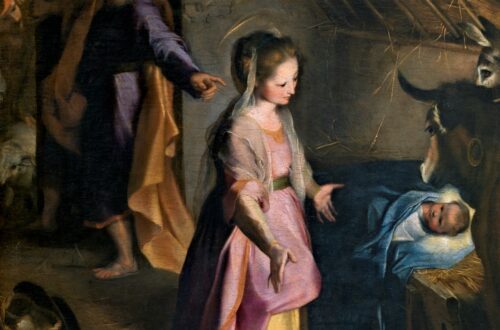
This time of year, we begin to focus on the small baby in the manger. The spotlight shines on Joseph, Mary, and Jesus, the holy family. We see these figures placed in many nativity scenes while driving around our community. Next, we see the wise men, the shepherds, and sometimes a few farm animals or camels. Rarely do we acknowledge the others in this story; Zacharias, Elisabeth, and John. However, this isn’t so much of a surprise since John the Baptist often sought to lower himself and remain humble even in his birth narrative.
The message of salvation is a dominant theme in this passage. It is easy to see why people misunderstood Christ’s mission. Some might wonder why God wouldn’t just remove everything that is frightful and evil and take away sin entirely to restore righteousness, justice, and peace to the world. It’s likely that the people during Christ’s time also thought like this. They might have envisioned getting ready to take up arms, to be delivered from their enemies of oppression during the Roman world the way God led their ancestors into battle; they were ready to fight. With this mindset, it’s surely that many were also disappointed when they were told thirty years later to love their enemies instead.
We are reminded of the words of Isaiah 9:6 (KJV), “for unto us a child is born, unto us a son is given: and the government shall be upon his shoulder: and his name shall be called Wonderful, Counsellor, The mighty God, The everlasting Father, The Prince of Peace.
We see this child as the Prince of Peace. But then we become confused when we hear Jesus saying:
Think not that I am come to send peace on earth:
I came not to send peace, but a sword.
Matt 10:34 (KJV)
What does Jesus mean here? Does He bring peace or not? We begin to theologize that He must have some kind of Peace that we don’t know about because in John 14:27 (KJV), he says, “Peace I leave with you, my peace I give unto you: not as the world giveth, give I unto you. Let not your heart be troubled, neither let it be afraid.
However, today, with tragedy reported hourly, we wonder, “Where is there peace?”
Turning back to verse 76-79:
76 And thou, child, shalt be called the prophet of the Highest: for thou shalt go before the face of the Lord to prepare his ways;
77 To give knowledge of salvation unto his people by the remission of their sins,
78 Through the tender mercy of our God; whereby the dayspring from on high hath visited us,
79 To give light to them that sit in darkness and in the shadow of death, to guide our feet into the way of peace.
The child was going to be called “the prophet of the Highest…” He was going to:
- He was going to prepare the way of the Lord.
- He was going to give knowledge of salvation to the people.
- He was going to demonstrate the tender mercy of God.
- He was going to give light to the ones who were in darkness…
He was going “to guide our feet into the way of peace.”
When is there peace?
The Bible always brings up a point “if there’s a will, there is a way.” From the book of Judges: And the priest said unto them, Go in peace: before the LORD is your way wherein ye go. Judges 18:6 (KJV).
From Proverbs: There is a way which seemeth right unto a man, but the end thereof are the ways of death. Prov 14:12 (KJV)
The way of life is above to the wise, that he may depart from hell beneath. Prov 15:24 (KJV)
From the gospel of Matthew: Enter ye in at the strait gate: for wide is the gate, and broad is the way, that leadeth to destruction, and many there be which go in thereat: Because strait is the gate, and narrow is the way, which leadeth unto life, and few there be that find it. Matt 7:13-14 (KJV)
From the gospel of John: Jesus saith unto him, I am the way, the truth, and the life: no man cometh unto the Father, but by me. John 14:6 (KJV)
Today’s gospel states that there is a “way of peace.”
I have to conclude that this does not mean that there will be peace on earth. Not as long as the forces of darkness remain will there be peace on earth.
But the way of peace says something much different. It means that there is a lifestyle of peace. There is an attitude of peace. There is a possibility for someone to have peace in the midst of suffering and turmoil. There is a rest in peace that may mean something far more literal and spiritual than what is printed on tombstones. There is a peace that passes all understanding. There is a peace that comes to those who seek God. And only His peace will sustain those who pray to live in peace in a troubled world.
When is there peace?
There is always a great possibility for peace. Truly, we must recognize Christ as the Prince of Peace. When His peace comes to satisfy, His peace is everlasting. I HOPE TODAY YOU RECEIVE PEACE.
Resources:
Bibleinterpretation.org. “Luke 01:67-80 The Canticle of Zechariah”